Tiny Habits: How Small Is Small Enough? Examples You Can Track
Tiny habits can start with one small action. See how to choose a size, scale it up, and track a 30-day example without turning it into a streak test.
By Ultimate Habit Tracker by Cosmo Suite · Editorial policy
Published · 7 min read
You want to read more, move a little, or put your phone away earlier, but a big version of the habit keeps getting postponed. Tiny habits start with a smaller action you can actually picture doing on a busy day.
There is no universal smallest size. BJ Fogg's Tiny Habits method pairs a very small behavior with an existing routine, then adds a celebration. You can keep that first step small, do more when you feel like it, and track the action you chose rather than turning every good day into a higher target.
What matters is whether the first action is clear, fits your day and is easy to record. Here is a way to choose its size and adjust it without making the tracker another task.
A tiny habit is a small action, not a small goal
Tiny Habits is a method BJ Fogg describes for making a new behavior very small, linking it to an existing routine, and celebrating after you do it. The smallness helps you get started; it does not decide how important the larger goal is.
BJ Fogg's Tiny Habits recipe cards describe three parts: an anchor moment, a tiny behavior and a celebration. An anchor is a routine you already do. The behavior follows it. The celebration is a small moment of positive feeling after you act. This is Fogg's named method, not a promise that one formula works for everyone. His overview of Tiny Habits also presents the small behavior as one part of a broader method.
In Fogg's guide to designing habits, he recommends pairing an existing anchor with a behavior and revising a recipe when the pairing does not work. That makes the method adjustable. A failed pairing is a reason to redesign it, not proof that you need a stricter goal.
For example: “After I pour my morning coffee, I will open my book.” Opening the book is the tiny action. Reading a chapter can happen too, but it is not required for the check-off to count. The starter action stays visible even when the rest of the day changes.
If “read for 30 minutes” keeps slipping, try “open the book after coffee” as the first step. That gives you a clear starting point to test and revise.

Tiny habits at a Glance
Choose a first action that feels easy to begin, then define what counts before you track it. The examples below are options, not instructions you need to adopt.
| Larger intention | Small first action | A natural place to try it | Best for |
|---|---|---|---|
| Read more | Open a book and read one sentence | After making coffee | A habit that feels too long to start |
| Walk regularly | Put on walking shoes | When you get home | A routine with a clear first step |
| Keep a journal | Write one line | After lunch | A habit that feels hard to make time for |
| Stretch more | Stand up and stretch once | After closing your laptop | A small action linked to an existing transition |
| Put your phone away at night | Place it on the charger | When you get into bed | A habit that needs a visible cue |
The action only needs to be small enough for your circumstances. You can change the anchor, shrink the action or try another version if the first pairing does not fit. For a different kind of cue-and-action plan, see how implementation intentions work for everyday habits.
Find a size that you can recognize
Make the first action specific enough that you can tell whether it happened. “Be healthier” is too broad to check off. “Put on my walking shoes after work” is visible, concrete and easier to record.
Try this three-part sizing check:
- Name the action. Choose something you can see yourself doing, such as opening a book or writing one line.
- Shrink the start. If you hesitate because of the time or effort, reduce the first step. You can read one page instead of finishing a chapter.
- Set the boundary. Decide what counts before the day gets busy. If the action is opening your book, opening it counts even if you do not continue.
The boundary is not a trick to inflate a score. It keeps the tracker aligned with the small action you deliberately chose. If your version changes, update the plan rather than silently changing what yesterday's checkmark means.

Keep the small version from turning into a new quota
A tiny habit can remain tiny, or you can decide to do more when you have the time and energy. Neither choice needs to become the rule for the next day.
Suppose your planned action is to read one page. Some evenings you may read ten. If you record the planned action, both evenings count because you completed at least one page. The extra pages are welcome, but they do not raise the minimum to ten tomorrow.
You can also keep separate check-offs for a starter action and a longer version, but that adds more decisions. For a simple tracker, pick the version you want to repeat and count that. If it stops fitting, choose a smaller or different action during your review.
The familiar cue-action-reward pattern and Tiny Habits both use a cue, but they are not interchangeable terms. Tiny Habits has a named recipe: an anchor, small behavior and celebration.
A sample month: one small action, several missed days
An illustrative month shows what a small action can look like on a tracker without turning it into a streak challenge. This sample is made up for explanation; it is not research data or a customer result.
Imagine a reader chooses “open my book after coffee” as the action for a 30-day month. They complete it on 24 days and leave six days blank. The month total is 24 ÷ 30 = 80%. On some completed days, they read more than one page. The tracker still records the action they chose.
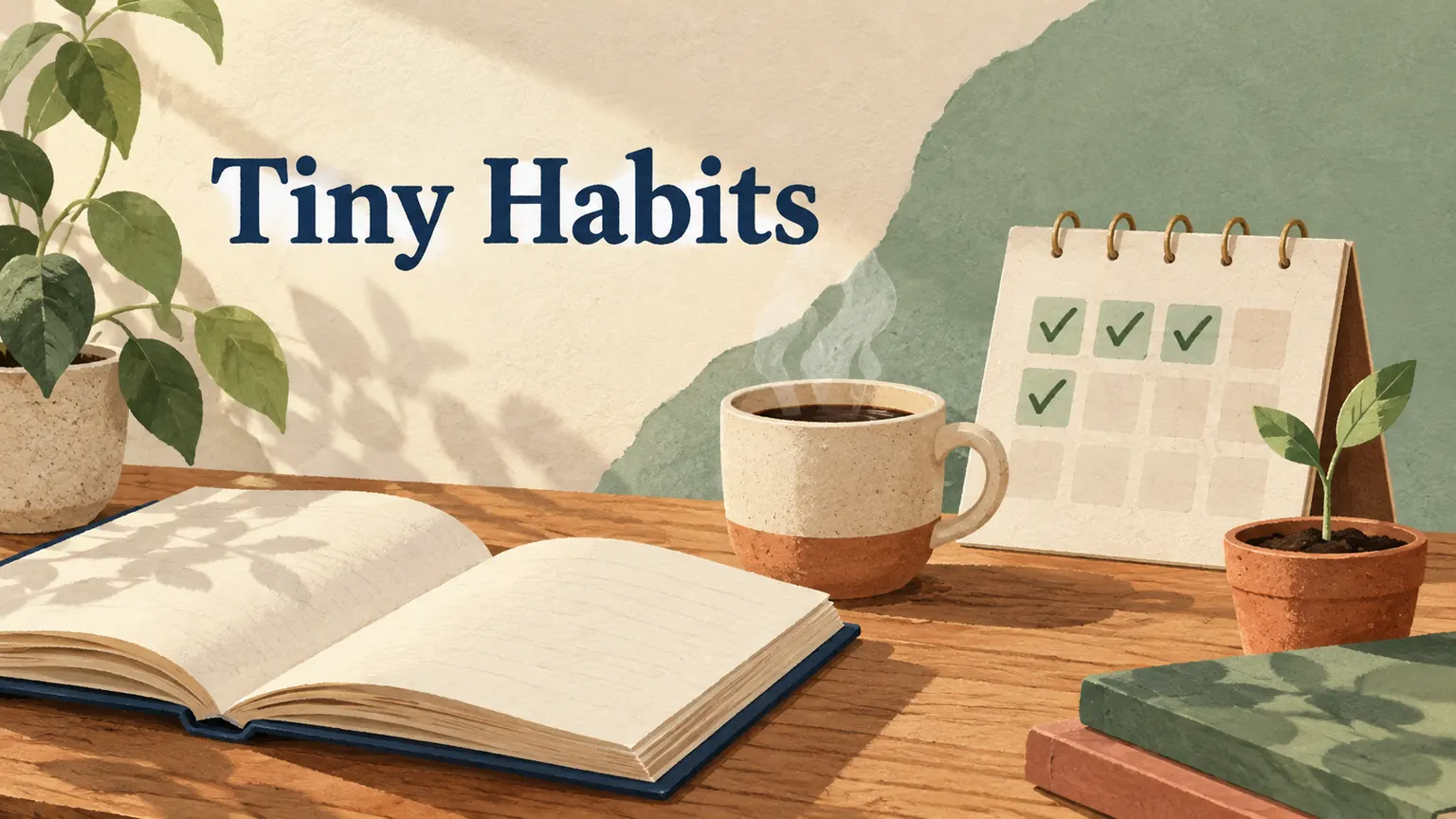
The percentage shows how many planned days the action happened. It cannot explain a blank day, measure effort or prove a habit has formed. A short note can add context, such as “late coffee” or “book out of reach.”
At the end of the week, the reader can ask whether the action felt small enough and whether coffee was a useful anchor. If the anchor did not happen on weekends, they can choose a more reliable routine. If the action felt too large, they can reduce it. Change one part, then see how it fits the next week.
What helps you keep coming back
Make the return easy by keeping the action clear, the record honest and the adjustment small. A tracker should help you see what happened, not grade your character.
Keep the check-off tied to your plan. If your plan is to open a book, do not move the goalpost to a full chapter because you managed it once. You can celebrate the extra reading without making it the new requirement.
Treat an empty box as information. A blank can mean the anchor did not occur, the action did not fit, or the day simply went another way. It does not erase previous check-offs. The habit tracker template guide explains how a month view can keep completed days visible beside missed ones.
Review in ordinary language. “I forgot my book” points to a different adjustment than “one page still felt like too much.” Pick one change you can test. You do not need to redesign your whole routine after a single miss.
Let consistency mean returning, not perfect rows. Some weeks will look different from others. A month record can show both the days you completed and the days you missed without asking you to start over.
One useful distinction in Fogg's Tiny Habits Toolkit is between the new behavior and the celebration that follows it. For a tracker, write down the behavior you mean to repeat. A celebration can be personal and need not become another box to complete.
Fogg's recipe card PDF gives the format “After I [anchor], I will [tiny behavior]. Then, I celebrate.” Use the format to make your chosen action concrete. If the action is still too much, rewrite only that part of the recipe.
Why Trust This Article
This guide describes BJ Fogg's named Tiny Habits method using his recipe cards, design guide and toolkit, checked on 29 October 2026. The month example is fictional arithmetic to explain tracking, not a study result. The Ultimate Habit Tracker is a spreadsheet made by Cosmo Suite; product details here follow its approved contents list. We do not claim that a tiny action guarantees a lasting habit. Learn more about Cosmo Suite, read the editorial policy, or contact the team with a correction.
Where the Ultimate Habit Tracker fits
The Ultimate Habit Tracker (ultimatehabittracker.site) is a spreadsheet for people who want a checkbox record they can keep and reuse. Its monthly tabs show daily check-offs and monthly completion, so an empty box does not hide the actions you already recorded.
You can set up to 25 habits, start with three, and use the included Excel and Google Sheets versions. The Setup tab lets you name a habit and choose its target days. The tracker does not send reminders or notifications, so it suits people who are comfortable opening a spreadsheet when they want to record a check-off.
If you want to see the Ultimate Habit Tracker spreadsheet, review the included habit tracker tabs and printable pages. The product costs $9 once according to the approved product context. It is built for Excel 365; older Excel versions may limit dashboards. Google Sheets requires a free Google account.
The fit is straightforward: choose an action that suits your day, record it in the month, and use the visible pattern to decide whether to keep or adjust the plan. The sheet can hold the record. You decide what the habit means to you.
Frequently asked questions
What is a tiny habit?
A tiny habit is a deliberately small version of a behavior you want to do. BJ Fogg's Tiny Habits method pairs it with an existing routine, called an anchor, and a celebration. The small action is a starting point, not a daily minimum everyone must follow.
How small should a tiny habit be?
Small enough that you can picture doing it on an ordinary busy day. That might mean opening a book, putting on walking shoes, or writing one sentence. If it still feels like a project, shrink the action or choose a simpler first step.
Do tiny habits have to take less than 30 seconds?
No universal time limit defines a useful small habit. The Tiny Habits method emphasizes making the behavior very small and easy to begin. Choose a size that fits your situation, then adjust it if the first step still creates friction.
Should I make a tiny habit bigger over time?
Only if you want to. You can keep the small version, do more when it suits you, or choose a larger planned version. Record what you intended to do so a bigger day feels like a bonus, not a new rule.
Can I track a tiny habit if I do more than planned?
Yes. Decide what counts before you start. If your tiny version is opening a book, check it off when you open it. Reading ten pages can be extra, but it does not need to become the new minimum.
How many tiny habits should I start with?
Start with one or a few actions that matter to you and fit existing parts of your day. More entries take more attention to track. Add another only when the first set feels easy to remember and record.
What is the fastest way to start a tiny habit?
Choose one action, shrink it until the first step feels clear, and connect it to a routine you already do. Write the exact action and check off whether you did that version. Review after a week and change one part if it did not fit.