Implementation Intentions: Three If-Then Plans for Habits That Stick
Implementation intentions turn a habit goal into a clear when-then plan. Write three small examples, track them for a month, and adjust after missed days.
By Ultimate Habit Tracker by Cosmo Suite · Editorial policy
Published · 8 min read

You want to read before bed, but the evening gets away from you. An if-then plan gives the habit a place to begin: “When I plug in my phone, I will read two pages.” The plan connects a familiar cue to one small action.
That kind of plan is called an implementation intention. It can help you act on a goal you already chose, especially when the first step is easy to forget. It cannot make every day predictable. Start with three ordinary habits, write a cue and response for each, then see which plans fit a real month.
What an Implementation Intention Does
An implementation intention is a plan that links a specific situation to an action: when X happens, I will do Y. The cue might be pouring coffee, arriving home, or finishing lunch. The response should be a clear action, such as reading two pages or putting on walking shoes.
Psychologist Peter Gollwitzer described these plans as a way to connect an opportunity with a goal-directed behavior. In a 1997 paper with Veronika Brandstätter, they reported higher completion of difficult personal projects when participants formed these plans. Their studies tested specific tasks and periods, so the result does not mean every written plan will work for every habit. For a related habit cue example, see how the habit loop links a cue to an action.
A broad goal like “read more” tells you what you want. A plan like “when I make tea after dinner, I will read two pages” gives the action a starting point. A cue does not have to be a clock time. An event already in your routine is usually easier to notice.
If-Then Plans at a Glance
Choose one familiar cue and pair it with a small response. The plan works best when both parts are easy to picture.
| Goal | If-then plan | Why this cue | Best for |
|---|---|---|---|
| Read more | When I pour my morning coffee, I will read two pages | Coffee happens before the action | A habit that needs a clear start |
| Walk after work | When I get home, I will put on my walking shoes | Arriving home is easy to notice | A habit that gets postponed |
| Use my phone less at bedtime | When I plug in my phone, I will open my book | Charging marks the end of phone use | A habit linked to an evening routine |
If you are already doing the action without thinking, you may not need a written plan. If the cue rarely happens, choose another one. [[product]]
Write Three Plans That Fit Your Day
The form is simple: “When [situation], I will [small action].” Write what you will do, rather than a result you hope to get. “When I sit down after lunch, I will walk around the block” gives you a first step. “When I sit down, I will get fitter” does not.

Try these steps:
- Pick a goal you already care about. A plan helps with action. It does not supply a reason to act.
- Choose a cue you can recognize. Link the habit to something that happens often enough and belongs in the same part of your day.
- Make the first action small. Two pages, a short walk, or placing your book beside the bed is easier to begin than a large outcome.
- Write one sentence. Keep one cue and one action together. If you need a paragraph to explain it, simplify the plan.
- Try it before adding more. Notice whether the cue occurred and whether the action fit. Change one part if it did not.
Start with three plans. You might read after pouring coffee, walk when you get home, and put your phone away when you plug it in at night. The plans use different parts of the day without requiring a new schedule.
Track the Plans Through a Month
A plan can sound tidy on paper and still miss the shape of your week. Use a simple month grid to record whether you did the action. The example below is sample data, not results from a study or a real person's tracking.
Imagine four habits tracked over 30 days: read two pages after coffee, walk after work, drink water with lunch, and put the phone away when charging at night. If you check off 26 days across one habit, that habit's month completion is 26 ÷ 30 = 87%. That percentage counts each day; it does not tell you why the other four were missed.
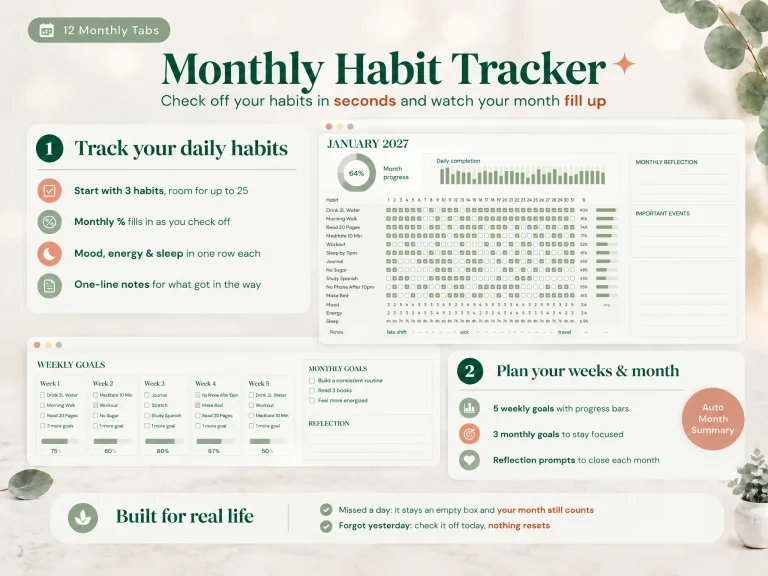
For each empty box, ask a practical question: did the cue happen? Was the response small enough? Did something unusual interrupt the routine? Those answers point to different edits. A missed cue may need a more reliable anchor. An action that feels too large may need a smaller first step. A one-off travel day may call for flexibility, not a brand-new plan.
If you want to see where a plan breaks, record the cue and the action separately for a few weeks. Mark whether the cue happened, then whether you completed the response. A cue that appears often with few actions calls for a smaller response. A cue that rarely appears calls for a different anchor. This quick comparison helps you change one part at a time and see whether the new version fits better.
The plan should help you notice an opportunity. It should not turn every unexpected day into a broken promise. Keep the sample month separate from research findings, and use the grid as a record of what you tried.
Review the three plans at the end of the week. If your cue happened and you completed the action, keep the sentence for another week. If the cue happened but the action did not, make the first step smaller or prepare what you need in advance. If the cue did not happen, replace it with a moment that is more common in your day. This gives you a concrete adjustment instead of rewriting the whole habit.
You can also decide what counts as a flexible version before you need one. For a walk, that might mean five minutes indoors when weather or travel changes the usual routine. For reading, it might mean one page instead of two when bedtime is late. The flexible version keeps the plan usable while leaving you free to choose what fits the day.
When a Plan Needs to Bend
There is a real limit to rigid planning. In two studies published in 2005, Theodore Powers, Richard Koestner and Raluca Topciu found that implementation intentions backfired for participants high in socially prescribed perfectionism: those participants reported worse progress on personal goals than people who completed a control exercise. The study abstract suggests plans may be a poor fit for some self-critical tendencies. It does not show that every perfectionist will be harmed.
If a plan starts to feel like another standard you must meet, loosen it. Instead of “when I get home, I will walk for 30 minutes,” try “when I get home, I will put on my shoes; a short walk counts.” You can also make a backup: “If it is raining when I get home, I will walk indoors for five minutes.”
Flexibility matters for another reason. Gollwitzer and Brandstätter’s 1997 research found that a plan is only useful when it connects a workable action to a useful opportunity. A systematic review of 24 physical activity studies also found that these plans were most useful for people who already had the intention and confidence to act. If you do not yet know what action will help, take time to choose one. A cue cannot fix an unclear goal or a response that does not suit the situation.
What Actually Helps You Come Back
Use a cue that already belongs to your day. “After I pour coffee” is easier to spot than “at 7:00,” especially when your mornings vary. If that moment changes often, choose another regular event.
Keep the first action modest. The plan is there to start the behavior. A short first step leaves room to continue when you have time and energy, while still giving you a way to begin on a busy day.
Review the cue and response separately. If you missed the plan, do not label the whole habit a failure. Check whether the cue happened, whether the response fit, and whether anything unusual got in the way. Change the part that caused friction.
Count the month as well as the streak. A streak can be useful feedback, but one missed day can hide the other days you showed up. A monthly percentage gives you another view. The habit tracker template with a monthly grid shows how to record each day without treating one blank box as a reset.
Why Trust This Article
We are the Cosmo Suite team that makes the Ultimate Habit Tracker, so we have a product interest. Read about Cosmo Suite and how we prepare and check articles. The research summary is based on the named papers, including the limits stated by their authors. The month figures are arithmetic on illustrative check-offs, not research data. Sources were checked on 21 October 2026. This is general information about everyday habits, not medical advice.
Where the Ultimate Habit Tracker Fits
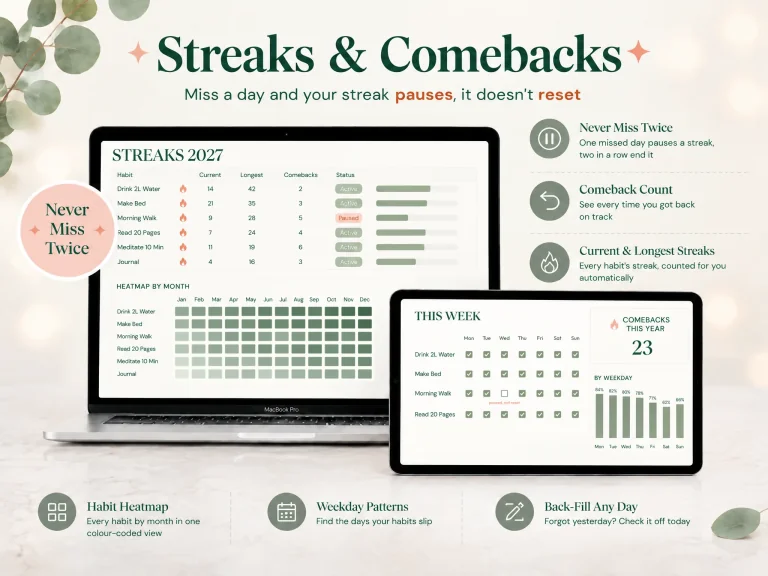
The Ultimate Habit Tracker (ultimatehabittracker.site) is a spreadsheet with 21 tabs across four sections, including 12 monthly trackers and a Setup tab for up to 25 habits. Both Excel and Google Sheets versions are included. The daily grid lets you check off a habit without typing, and the month percentage updates automatically.
You can put a short cue or plan in a monthly notes field, then see your check-offs across the month. A missed day pauses a streak, a forgotten day can be filled in later, and comebacks are counted. It does not send reminders or notifications.
The product costs $9 once and can be reused each year. If you want a ready-made habit tracker spreadsheet for Excel and Google Sheets, you can compare its tabs before choosing. The monthly habit tracker template gives you a place to see the plan and the actual check-offs together.
Frequently asked questions
What is the intention-action gap?
It is the space between deciding to do something and doing it. An implementation intention narrows that gap by connecting a specific situation to a specific action, such as, 'When I put the kettle on, I will read two pages.' It can make the first step easier to remember, but it cannot guarantee follow-through.
What is a behavioral intention?
A behavioral intention is a plan or commitment to do an action, such as 'I intend to walk more.' An implementation intention adds a cue and response: 'When I get home, I will put on my walking shoes.' The second version makes the situation and action more concrete.
How do I write an implementation intention?
Name a situation that already happens, then pair it with one small action: 'When X happens, I will do Y.' Make X easy to notice and Y easy to start. Write one plan first, try it in ordinary life, and revise it if the cue rarely happens.
Can implementation intentions backfire for perfectionists?
They may. In two 2005 studies, Powers, Koestner and Topciu found worse goal progress among participants high in socially prescribed perfectionism who formed these plans. That result does not describe every person or every kind of perfectionism. If a plan adds pressure, make it flexible or stop using it.
How many habits should I plan at once?
Start with one to three habits. Each plan should connect one familiar cue with one action. A longer list takes more writing and gives you more to maintain, so add another only when your first plans feel easy to remember.
Do if-then plans work every time?
No. Studies suggest they can help translate a chosen goal into action, especially when the cue and response are specific. They cannot create motivation, time, skill or a good opportunity when those are missing. Treat the plan as a prompt you can adjust, not a promise about what will happen.
What is the fastest way to try one?
Choose a habit you already want to do, attach it to a cue that is part of your day, and write one short if-then sentence. For example: 'When I pour my morning coffee, I will read two pages.' Check off whether you did it, then change the cue or action if the plan does not fit.
Sources
- Gollwitzer and Brandstätter (1997), Implementation Intentions and Effective Goal Pursuit, Journal of Personality and Social Psychology
- Powers, Koestner and Topciu (2005), Implementation Intentions, Perfectionism, and Goal Progress, Personality and Social Psychology Bulletin
- Gollwitzer and Sheeran (2006), Implementation Intentions and Goal Achievement: A Meta-Analysis of Effects and Processes
- Kompf (2020), Implementation Intentions for Exercise and Physical Activity: Who Do They Work For? A Systematic Review
