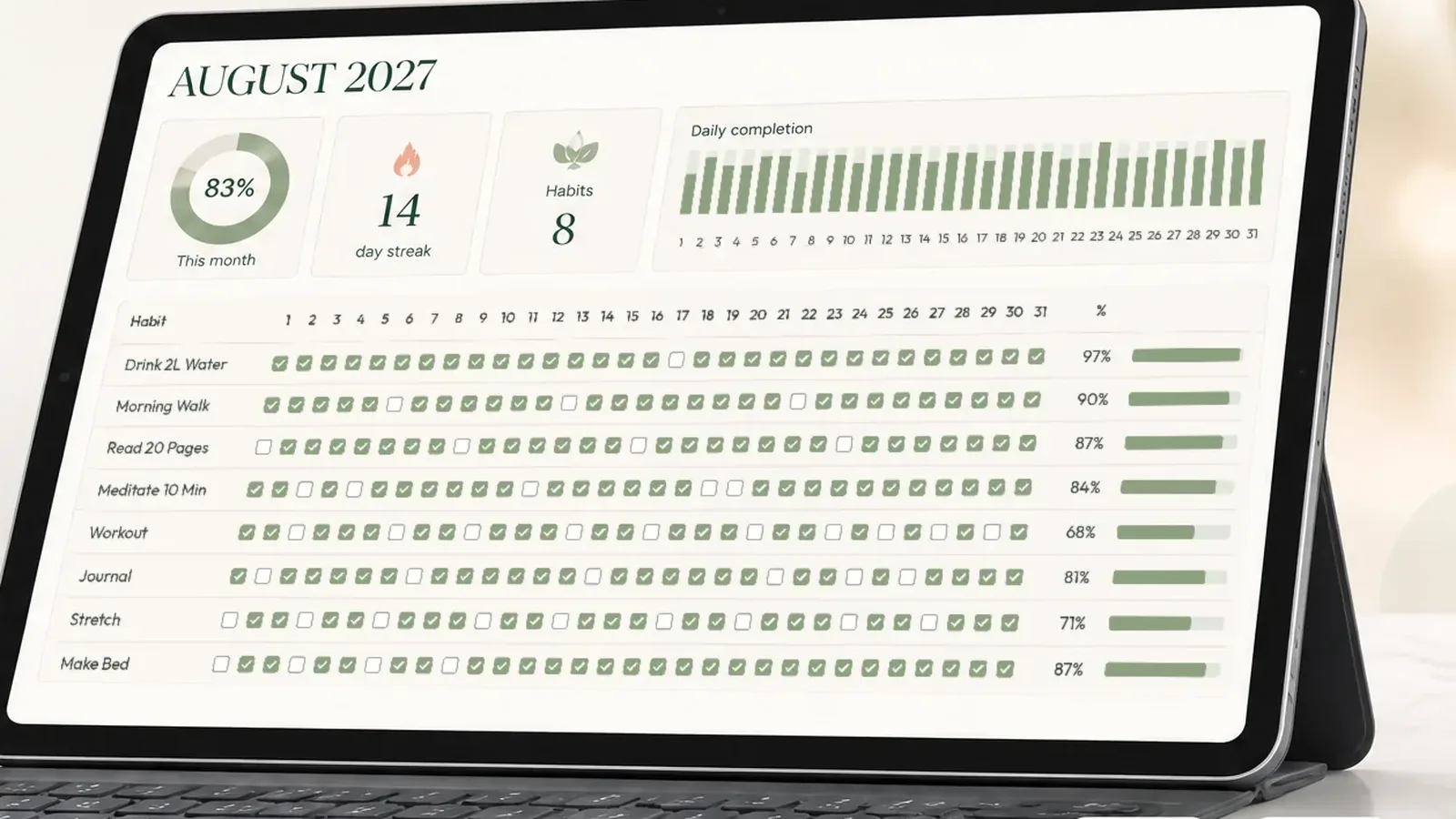
Habit Tracker Templates That Survive Week 3 (Matched to How You Track)
Habit tracker template checklist: 7 things a template needs to last past week 3, the formats compared on a missed day, and whether free or paid fits you.
By Ultimate Habit Tracker by Cosmo Suite · Editorial policy
Published · 8 min read
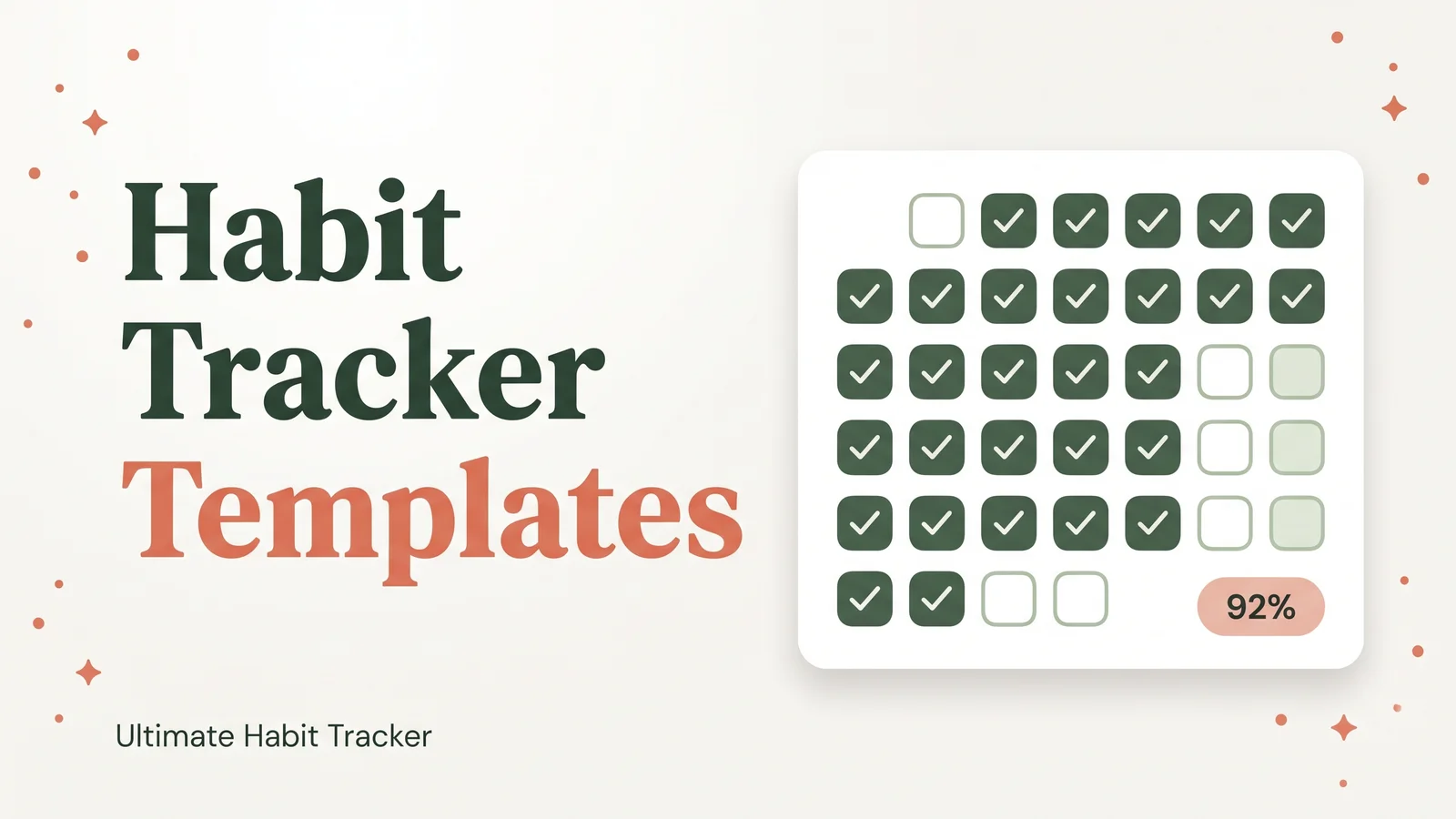
You start a new habit tracker on a Monday and check off every box for two weeks. Then a sick Tuesday and a travel Wednesday leave two empty boxes in a row, and by Sunday you have stopped opening it. Most habit tracker templates fail at that moment of discouragement rather than during the setup, because nothing in the design anticipates a difficult week.
The short answer: pick a habit tracker template by how it treats a missed day, then check six more things. It should show a monthly score, take seconds to fill in, start with three habits, open on your phone, avoid a subscription and let you see the month at a glance. Below is the full checklist, the formats compared, and when a ready-made habit tracker spreadsheet is worth paying for.
What a Missed Day Does to a Template
A missed day should cost a template one empty box. In many templates it costs the whole streak, which is why people quit.
Research points the same way. Phillippa Lally and colleagues at University College London followed 96 undergraduates for 84 days. The British Psychological Society's Research Digest reports that a single missed day had little impact on later automaticity gains. The average time to reach peak automaticity was 66 days, and individuals ranged from 18 days to a predicted 254.
A streak is the count of consecutive days you completed a habit, and a monthly score is the share of boxes you checked. Which of the two a template puts first matters a great deal.
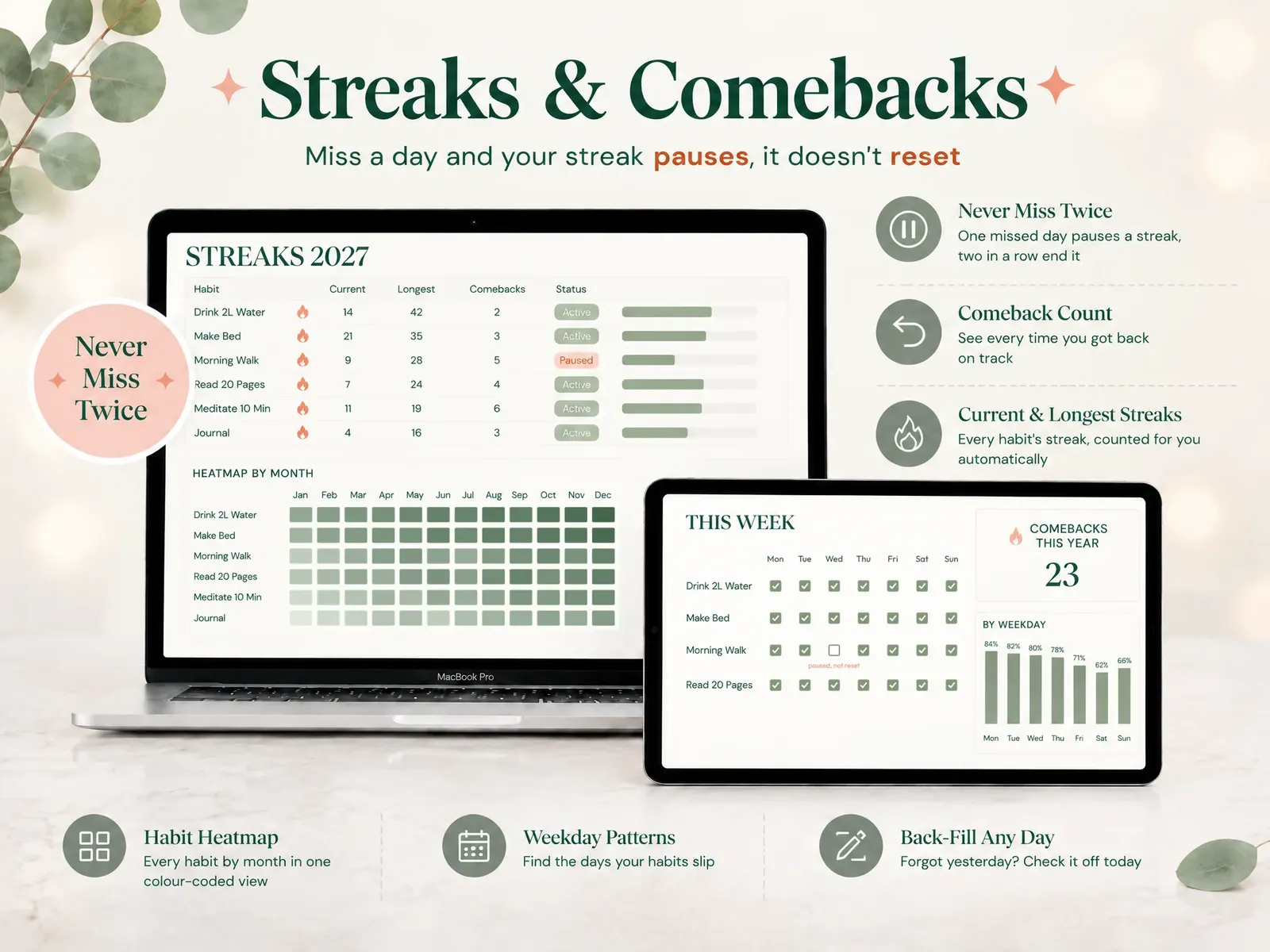
A template that resets to zero on one miss is working against the finding. A template that records the miss, for example, keeps counting the days you did show up and ends a streak only after two misses in a row is working with it.
Habit Tracker Templates at a Glance
Five formats cover almost every template you will find, and they differ most in what happens after a miss and in how much typing each one demands.
| Format | What a missed day does | Typing needed | Best for |
|---|---|---|---|
| Notion template | Depends on the creator's formulas | Taps, plus a Notion learning curve | People already living in Notion |
| Google Sheets template | Depends on the formulas in the copy you make | Checkboxes, but editing cells on a phone is fiddly | Phone-first spreadsheet fans |
| Excel template | Depends on the formulas; checkboxes need Microsoft 365 | Checkboxes on desktop | People who work offline |
| Printable PDF | An empty box, no totals | A pen | People who like a fridge-door tracker |
| Habit app | Often resets the streak | Taps and reminders | People who want notifications |
Notion's Habit Tracking category lists 3,060 templates, all shown as free, when we checked on 5 October 2026. Choice is not the problem; knowing which template will still be in use after three weeks of ordinary, interrupted life is.
Seven Things a Template Needs to Survive Week 3
In our own research we read and coded 943 public comments about habit trackers (Reddit, X, forums, app reviews and YouTube) while building the Ultimate Habit Tracker. The same complaints return. Each check below matches one of them, with the share of comments that raised it.
1. A missed day is an empty box: the check that decides the rest
About 10.4 percent of the comments describe one missed day making the whole tracker feel broken. One reader wrote that every tracker they tried "made me feel like a failure". The fix is a rule written into the template, not extra willpower.
Check for: an empty box that does not reset anything, and a streak that pauses on one miss and ends on two ("never miss twice").
2. The month is the headline number
A streak can shrink to zero overnight after a single miss, whereas a monthly percentage barely moves after one.
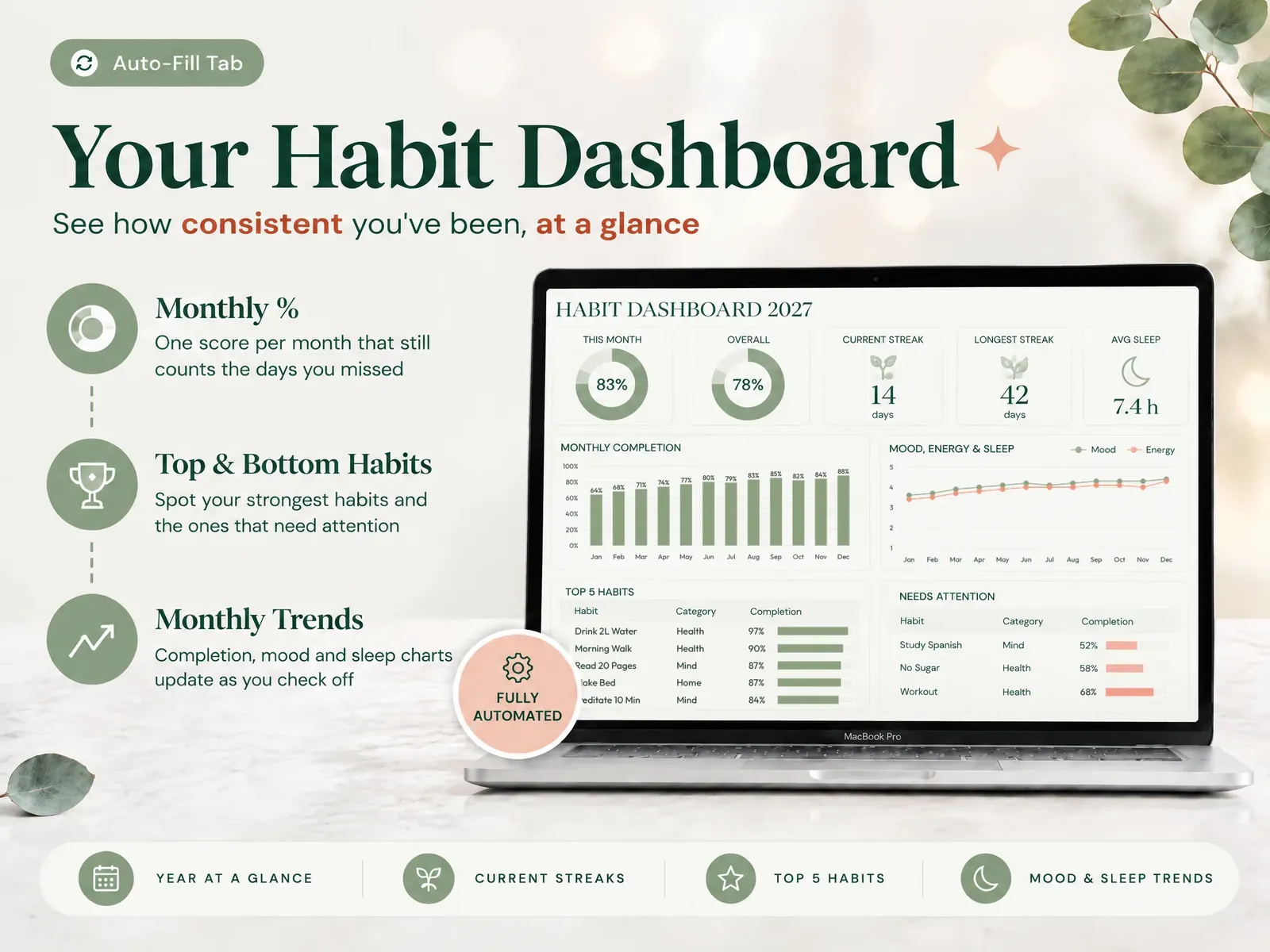
Check for: a month % at the top of the page, counting every day you showed up.
3. Checking off takes seconds
About 8.2 percent of comments say the tracker turned into admin: too many screens, too much upkeep. One reader called it anything that "feels like admin".
Check for: a checkbox per habit per day, with habit names typed once. Both Google Sheets and Excel for Microsoft 365 have in-cell checkboxes, per Google's checkbox guide and Microsoft's checkbox page.
4. It starts with three habits
Roughly 3.1 percent of comments say trying to track everything at once led to overwhelm, and more mention it in passing. Ten mostly empty rows on day one is a discouraging way to begin.
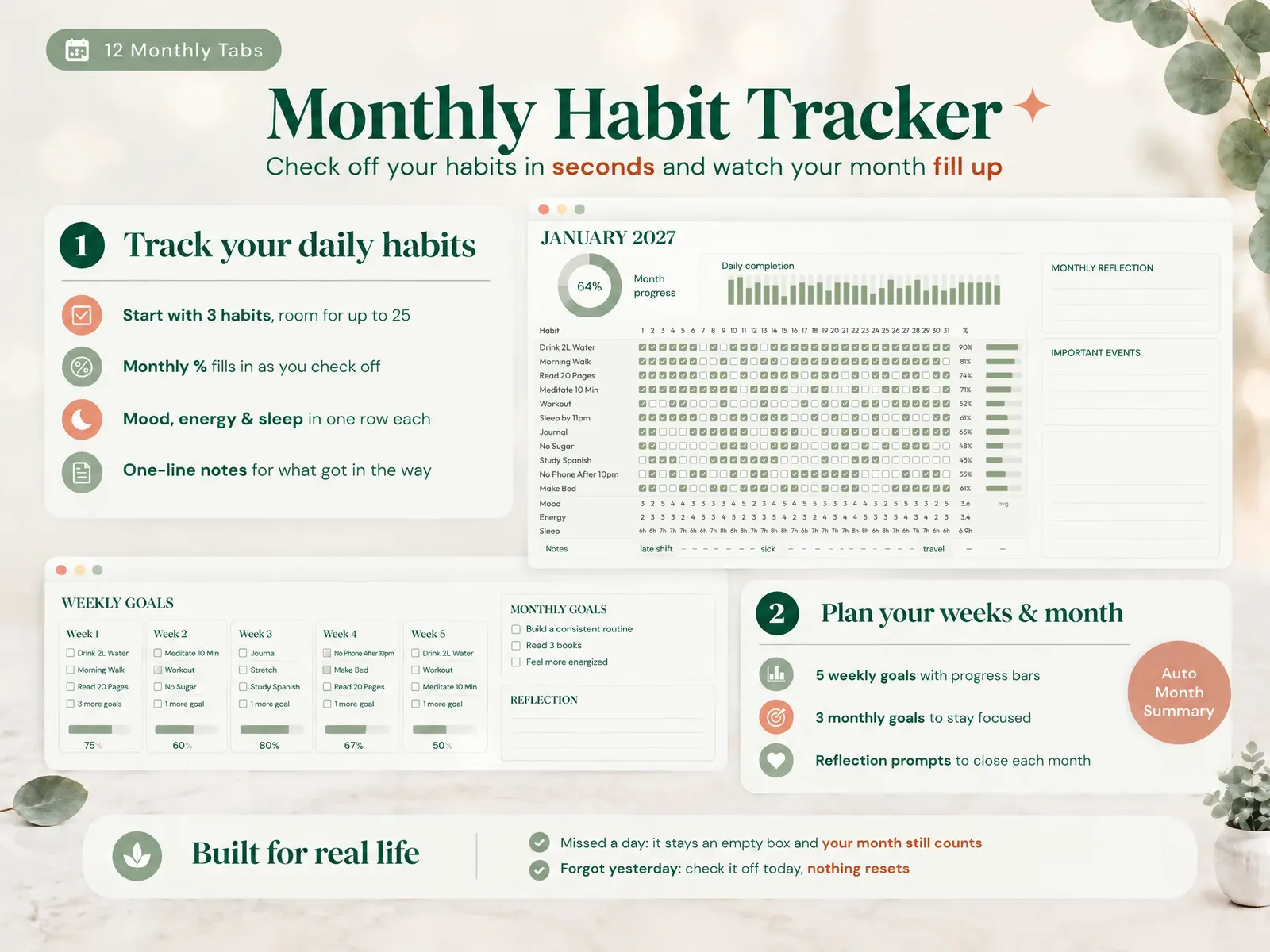
Check for: room for 3 habits to begin and room to grow later (the Ultimate Habit Tracker allows up to 25).
5. You can see the month at a glance
Readers ask for colored boxes and a filled-in month. A page of plain numbers rarely feels like progress.
Check for: color that shows the month's pattern in one look, plus a year view for later.
6. It opens where you actually check off
Typing into cells on a phone is a recurring complaint in our research. A template that you can only open on a laptop is, realistically, one that you will only open on weekends.
Check for: checkboxes that work on your phone, or a printable that sits where you will see it.
7. You own it and pay once, if you pay at all
About 11.1 percent of comments are about paying a subscription for what one called a "checkbox app". A file that you own cannot increase its price or restrict its free tier at some later date.
Check for: a one-time price or a free file, no account, and a copy you can keep.
One Week 3, Scored Both Ways
[Original data] Here is a sample three-week stretch with three habits and a few missed days. These are example check-offs, not a real person's data. The numbers come from applying the formulas to them.
| Habit | Days checked (of 21) | Score | Classic streak on day 21 | Never-miss-twice streak on day 21 |
|---|---|---|---|---|
| Walk 20 minutes (missed days 8 and 16) | 19 | 90% | 5 | 19 |
| Read 10 pages (missed days 9, 10 and 17) | 18 | 86% | 4 | 10 |
| Drink 2 liters of water | 21 | 100% | 21 | 21 |
| All habits | 58 of 63 | 92% |
[Unique insight] The classic streak penalizes your strongest habits hardest. Water was checked every day and walking on 19 of 21, yet walking shows a streak of only 5. The classic streak says walking is at 5 and reading is at 4, which feels like starting over. The score says you showed up on 92 percent of the 63 boxes. Reading's two misses in a row on days 9 and 10 ended its streak under never-miss-twice, and it rebuilt to 10 by day 21. That difference is the one that decides whether you open the file on day 22.
Free or Paid: What the Price Buys
Start with a free template if a simple grid is enough for your needs, and pay only when you want the rules and the year view already built for you.
A free template gives you the grid. Never miss twice is the rule that one missed day pauses a streak and two in a row end it, and most free grids do not include it. Our research includes a reviewer who said most Google Sheets templates are "just too basic", and the common gaps are streak rules, a year view and linked months. You can add those yourself, and our guide to building the sheet yourself, formulas included shows how, but it takes an evening and upkeep.
A paid template buys that evening back, along with the maintenance that follows it. The Ultimate Habit Tracker is $9 once. Compare that with the cost of a habit app subscription over a year or more, and pick the one you will still open in week 3.
| Free template | Paid template ($9 once) | |
|---|---|---|
| Setup | Copy and adjust | Fill in your habits |
| Missed-day rule | Whatever you write | Built in |
| Year view | Usually build your own | Included |
| Upkeep | Yours | None |
| Best for | People who enjoy building | People who want it done |
What Keeps You Coming Back After Week 3
The template matters less than three small routines around it.
Record it somewhere you can see. The evidence for this is better than you might expect. Harkin and colleagues pooled 138 experiments with 19,951 participants and found that monitoring goal progress helped people reach their goals (d+ = 0.40). The effect was larger when progress was physically recorded, according to the meta-analysis in Psychological Bulletin. A checkbox grid, like the monthly tab in this habit tracker spreadsheet, is a physical record you can see at a glance.
Check off at the same moment every day. Right after dinner is one reasonable option, and if you forget, you can fill yesterday in today, which is honest as long as you really did the habit.
Review once a week. On Sunday, look at which habit slipped and what got in the way. For example, if Tuesday is always the day you miss, ask whether a smaller version of the habit would fit that day. Add a fourth habit only when the first three feel easy.
Why Trust This Article
We are the Cosmo Suite team that makes the Ultimate Habit Tracker, so we are not neutral; read about us and our editorial policy. The percentages come from our own review of 943 public comments, not a survey. The week 3 table applies our formulas to sample check-offs. The habit research comes from the BPS summary of Lally et al. and the Harkin meta-analysis. Notion's count and the checkbox details were checked on 5 October 2026. Verify prices and features before you buy.
Where the Ultimate Habit Tracker Fits
The checklist is easy to read and harder to build. Steps 1 and 2 need formulas, and step 5 needs conditional colors across twelve months.
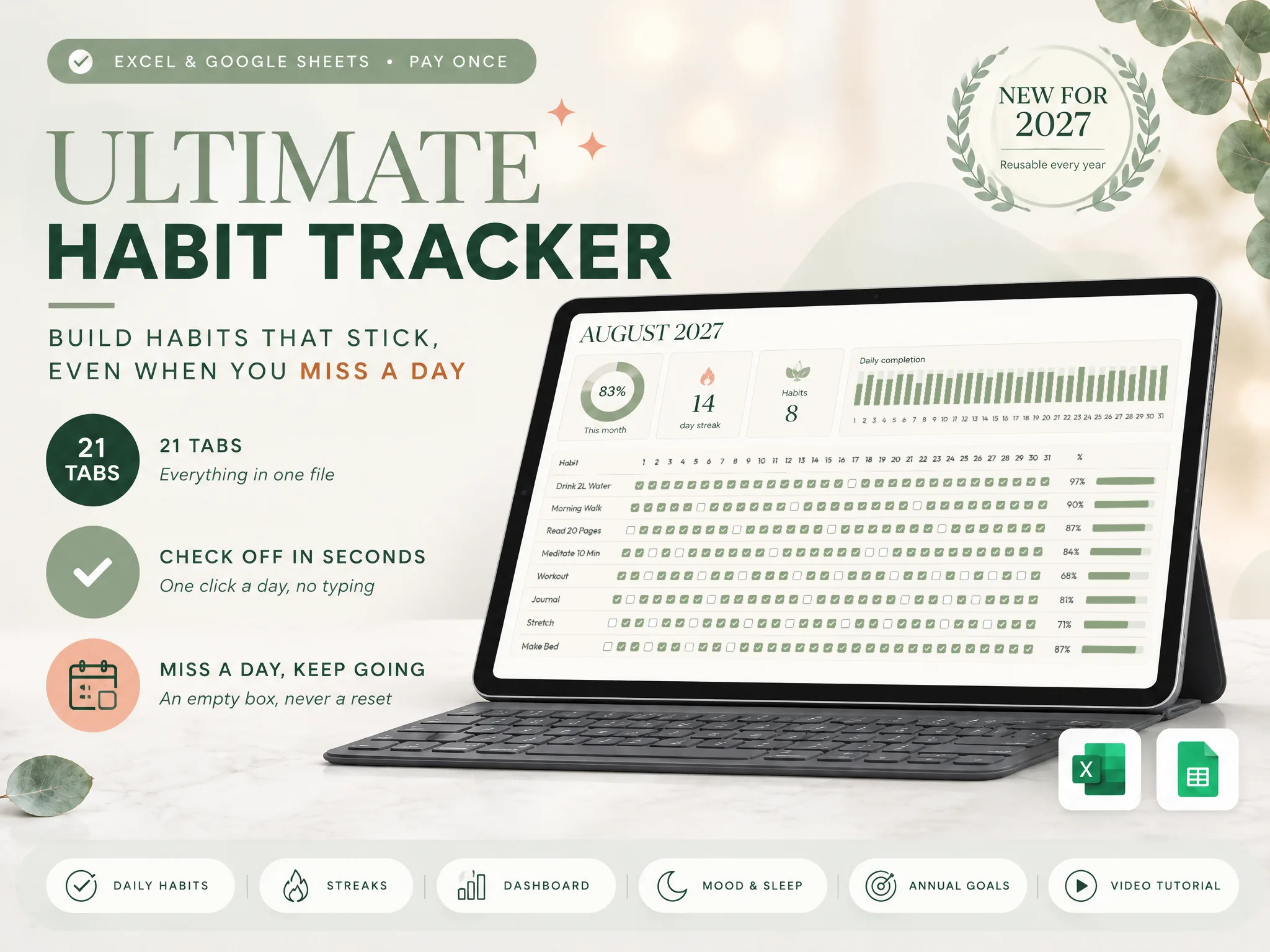
The Ultimate Habit Tracker is that spreadsheet, already built. It has 21 tabs in 4 sections, a monthly grid for up to 25 habits, and Excel and Google Sheets copies, both included. You check off a habit in seconds with no typing. A missed day pauses your streak instead of resetting it, a forgotten day can be filled in later, and comebacks are counted. A dashboard shows the month, and a year in review is automatic.
It does not send reminders, by design, so you open it whenever you are ready to check off your day. You pay $9 once and reuse it every year. You can see every tab in the habit tracker template for Excel and Google Sheets before you decide.
Frequently asked questions
What is the best format for a habit tracker template?
The format you will open on a bad day. A spreadsheet suits people who want to own the file and see a monthly score. Paper suits people who like a pen. An app suits people who want reminders. Whatever you choose, check how it treats a missed day, because that decides whether you return.
Are there free habit tracker templates?
Yes. [Notion's Habit Tracking category](https://www.notion.com/templates/category/habit-tracking) lists 3,060 templates, and every one shown there was free when we checked on 5 October 2026. Free printables and sheets exist too. The trade-off is usually the missed-day rule and the year view, so test one for a week before building on it.
How do I create my own habit tracker?
Start with a grid: habits down the side, days across the top, a checkbox in every cell. Add one formula for the monthly percentage. Keep it to three habits. Our guide to building a habit tracker spreadsheet walks through the formulas for Excel and Google Sheets.
How many habits should a template track at the start?
Three. A short list keeps checking off to a few seconds and leaves room for a bad week. Add a fourth only when the first three happen without much thought. Many people who quit trackers say they began with too many habits.
Does missing one day ruin a habit?
No. In the University College London study by Lally and colleagues, a single missed day had little impact on later automaticity gains. The average time to reach peak automaticity was 66 days. A template that records a miss as an empty box matches that finding better than one that resets to zero.
Is a paid habit tracker template worth it?
It can be, if it saves you building the rules and the year view yourself. The Ultimate Habit Tracker costs $9 once with no subscription. A free template is the better choice if you enjoy building your own and a simple grid is enough for you.
Sources
- BPS Research Digest: How long does it take to form a habit? (on Lally et al., 2010)
- Harkin et al. (2016), Does Monitoring Goal Progress Promote Goal Attainment? A Meta-Analysis of the Experimental Evidence, Psychological Bulletin
- Notion Template Gallery: Habit Tracking
- Google Docs Editors Help: Add & use checkboxes
- Microsoft Support: Using check boxes in Excel