The Habit Loop Explained: Cue, Routine, Reward on One Tracked Habit
The habit loop is cue, routine, reward. See all three tracked in separate columns for one habit across a month, and what to do when a day goes missing.
By Ultimate Habit Tracker by Cosmo Suite · Editorial policy
Published · 8 min read
You meant to read before bed, and then it was midnight and the book was still on the shelf. The next night the same thing happened. Most people blame themselves at this point, when the real question is which part of the habit went missing.
The short answer: the habit loop is a cue, a routine and a reward. The cue starts the habit, the routine is what you do, and the reward is why your brain wants to do it again. When a habit does not stick, one of the three is usually weak or missing. Below is the loop on one habit, tracked in three columns across a month, with what to do about the days that went wrong.
What the Habit Loop Is
The habit loop is a three-part cycle that repeats until the action feels automatic. A cue is the trigger that starts it, a routine is the action, and a reward is the payoff that makes your brain want a repeat. Charles Duhigg named the three parts in The Power of Habit (2012): cue, routine and reward. James Clear's Atomic Habits (2018) splits the same cycle into four steps: cue, craving, response and reward.
- Cue: the trigger. A time, a place, a feeling or something you just finished.
- Routine: the action itself. Also called the response.
- Reward: what you get out of it. Also the reason you do it again.
Take one habit, reading 10 pages. The cue is getting into bed. The routine is reading 10 pages. The reward is a finished chapter and a quiet end to the day. Written that way, the habit becomes something you can check off each day, and that is exactly the point where a tracker starts to help rather than get in the way.
The Habit Loop at a Glance
Each part of the loop fails in its own characteristic way, and each kind of failure calls for a different correction.
| Part | Example | How it fails | Fix | Best for |
|---|---|---|---|---|
| Cue | Getting into bed | You forget, or the cue never happens | Pick a cue that happens every day anyway | Habits that "slip your mind" |
| Routine | Read 10 pages | The action is too big on a tired night | Shrink it to 2 pages | Habits you skip when tired |
| Reward | A finished chapter | Nothing feels good afterward | Add a visible win, like a filled box | Habits that feel pointless |
A tracker gives you a reward you can see, since a filled box is a small win and a colored month, built up one box at a time, is a bigger one that you can look at whenever your motivation dips.
One Habit Tracked Across a Month
[Original data] Here is the loop on one habit, read 10 pages, over a 30-day month. These are example check-offs, not a real person's data. The numbers come from applying the scoring to them.
| Column | What you write |
|---|---|
| Cue | Getting into bed |
| Routine | Read 10 pages |
| Reward | Check the box, see the month fill in |
| Checked days | 26 of 30 |
| Missed days | 9, 10, 18 and 27 |
The month score is 26 of 30, which is 87%. Now compare the two ways of counting a streak on day 30.
| Rule | Streak on day 30 | Longest streak |
|---|---|---|
| Classic: any miss resets to zero | 3 | 8 |
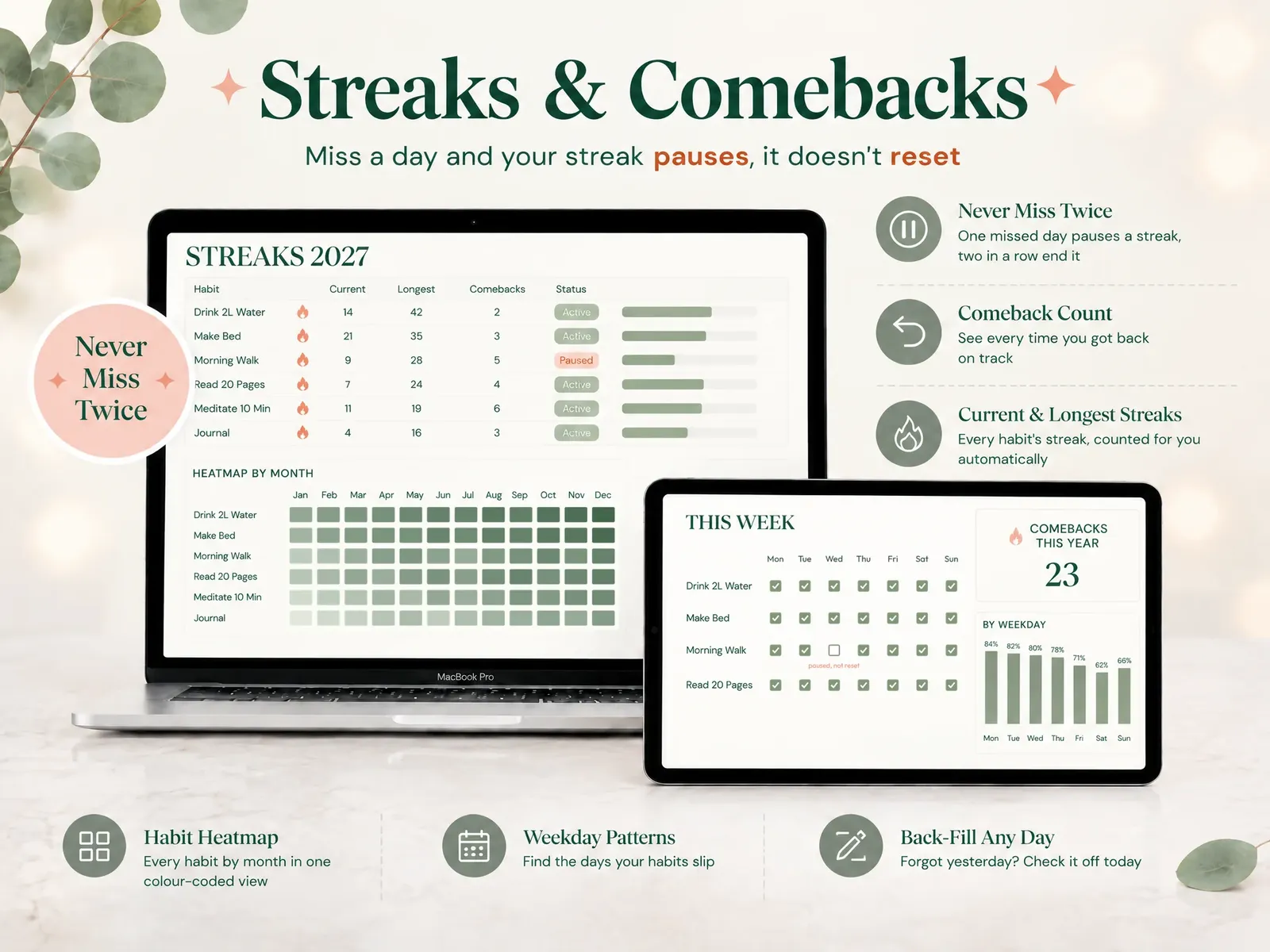
| Never miss twice: one miss pauses, two in a row end it | 18 | 18 |
Under the classic rule, days 9 and 10 reset the count, and the streak on day 30 is only 3 because day 27 was missed. Under never miss twice, day 18 and day 27 were single misses, so they paused the streak and did not end it. Only days 9 and 10, two in a row, ended it. From day 11 to day 30 you checked 18 days, and that run is the streak. [Unique insight] The loop did not break on day 27. The classic count says it did.
Three More Habits, Three Loops
The same three-part division works on practically any habit you might choose. Here are three, written the way a tracker row would hold them, with the part most likely to fail.
| Habit | Cue | Routine | Reward | Weakest part |
|---|---|---|---|---|
| Walk | Shoes by the door after lunch | 10-minute walk | Fresh air, a filled box | Cue (weather, meetings) |
| Water | Sitting down for each meal | One glass | Box checked three times a day | Reward (nothing to feel) |
| Phone off by 10pm | Plugging in the charger | Phone stays outside the bedroom | A quiet last hour | Routine (the urge to check) |
Notice that none of these cues is a time of day. Each one is something you already do, which is why they survive a messy Tuesday. Ask yourself: what do I already do every day that could carry this habit?
How to Write Your Own Loop
Spend roughly five minutes completing three concise lines for a single habit. Do this for one habit first, not ten.
- Pick the cue. Choose a dependable moment that occurs daily regardless of your mood, such as pouring coffee.
- Shrink the routine. Write the smallest version that still counts. Two pages beats zero pages.
- Name the reward. Write what you will get, even if it is only a checked box and a fuller month.
- Check it for a week. If you miss two days in a row, change one part of the loop. Change only one, so you can tell which part was the problem.
Afterwards, consider adding a second habit once the first feels comfortable. Many people who quit trackers say they began with too many habits, so three is a good ceiling at the start.
What a Missed Day Does to the Loop
A missed day removes a single repetition of the loop, but it does not remove the loop itself. The association between cue and routine builds up across many repetitions, not on any single day.
Phillippa Lally and colleagues at University College London followed 96 people for 84 days as they built a new habit. The British Psychological Society's Research Digest reports that a single missed day had little impact on later automaticity. The average time to reach peak automaticity was 66 days, with a range of 18 to a predicted 254. The study, published by Lally, van Jaarsveld, Potts and Wardle in the European Journal of Social Psychology in 2010, asked people to pick one eating, drinking or exercise behavior and report each day how automatic it felt. The old idea that a habit takes 21 days does not match those results. Because the range is so wide, a fixed number of days is less useful than watching how automatic the behavior feels as the weeks pass.
A later review points the same way. A 2024 systematic review of 20 studies with 2,601 participants found median times to habit formation of 59 to 66 days, with individual times from 4 to 335 days. The authors conclude that habits can start forming within about two months but that the time varies a great deal from person to person. They also note that most of the included studies had a high risk of bias, so treat the numbers as a range, not a promise.
Two misses in a row are a different matter, because they suggest the cue stopped working or the routine got too big. That is the moment to change the loop, and it is what the never miss twice rule is for. Meaningful consequences follow from that finding for anyone designing a tracker, which is why the template checklist puts the missed-day rule first.
What Actually Keeps You Coming Back
Three small adjustments help the loop continue through ordinary, interrupted weeks, when motivation is unreliable.
Anchor the cue to an event that already happens without any effort from you. Brushing your teeth, pouring coffee and getting into bed all happen on their own. Attach the routine to one of them rather than to a time like 7pm, which a busy day can skip.
Make the routine considerably smaller than you believe it needs to be. If 10 pages feels heavy on a tired night, 2 pages still counts as a checked box. You can scale up when the habit feels easy.
Make the reward visible. Checking a box is the reward most people underuse, and both Google Sheets and Excel for Microsoft 365 support in-cell checkboxes, so the box can be a real one. A grid that fills with color shows the month at a glance, and a month that is 87% full feels like progress even with four empty boxes.
When a habit stalls, name the part. For example, if you keep missing Wednesdays, the cue may be the problem, since Wednesday is the day your usual surroundings disappear. Ask: did the cue not happen, was the routine too big, or did the reward feel empty? Change that one part and keep the other two.
Why Trust This Article
We are the Cosmo Suite team that makes the Ultimate Habit Tracker, so we are not neutral; read about us and our editorial policy. The month table applies our scoring to sample check-offs and is not a study. The habit research comes from the BPS summary of Lally et al. The loop terms come from Duhigg's and Clear's books. Sources were checked on 13 October 2026. This is general information about everyday habits, not medical advice.
Where the Ultimate Habit Tracker Fits
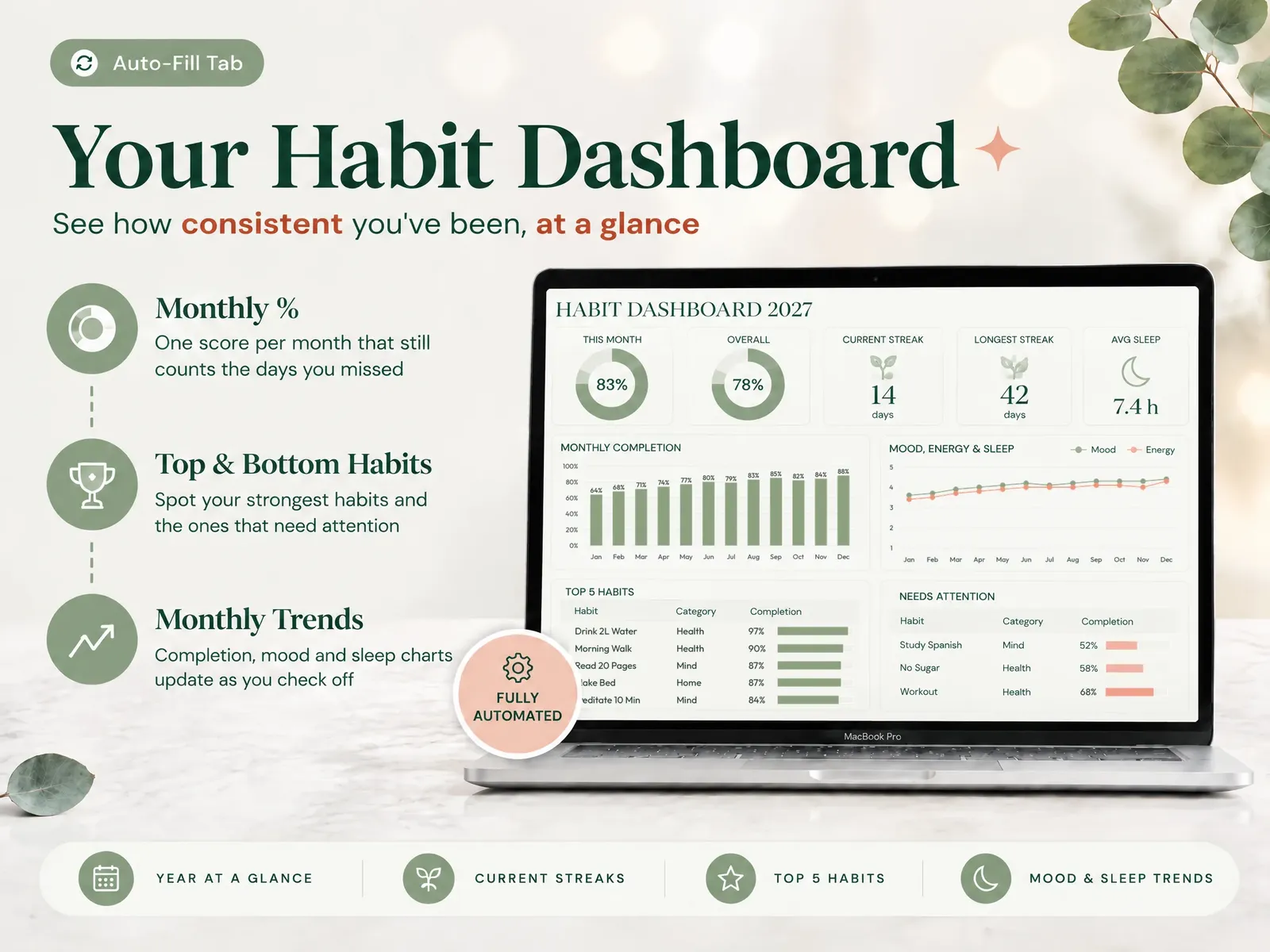
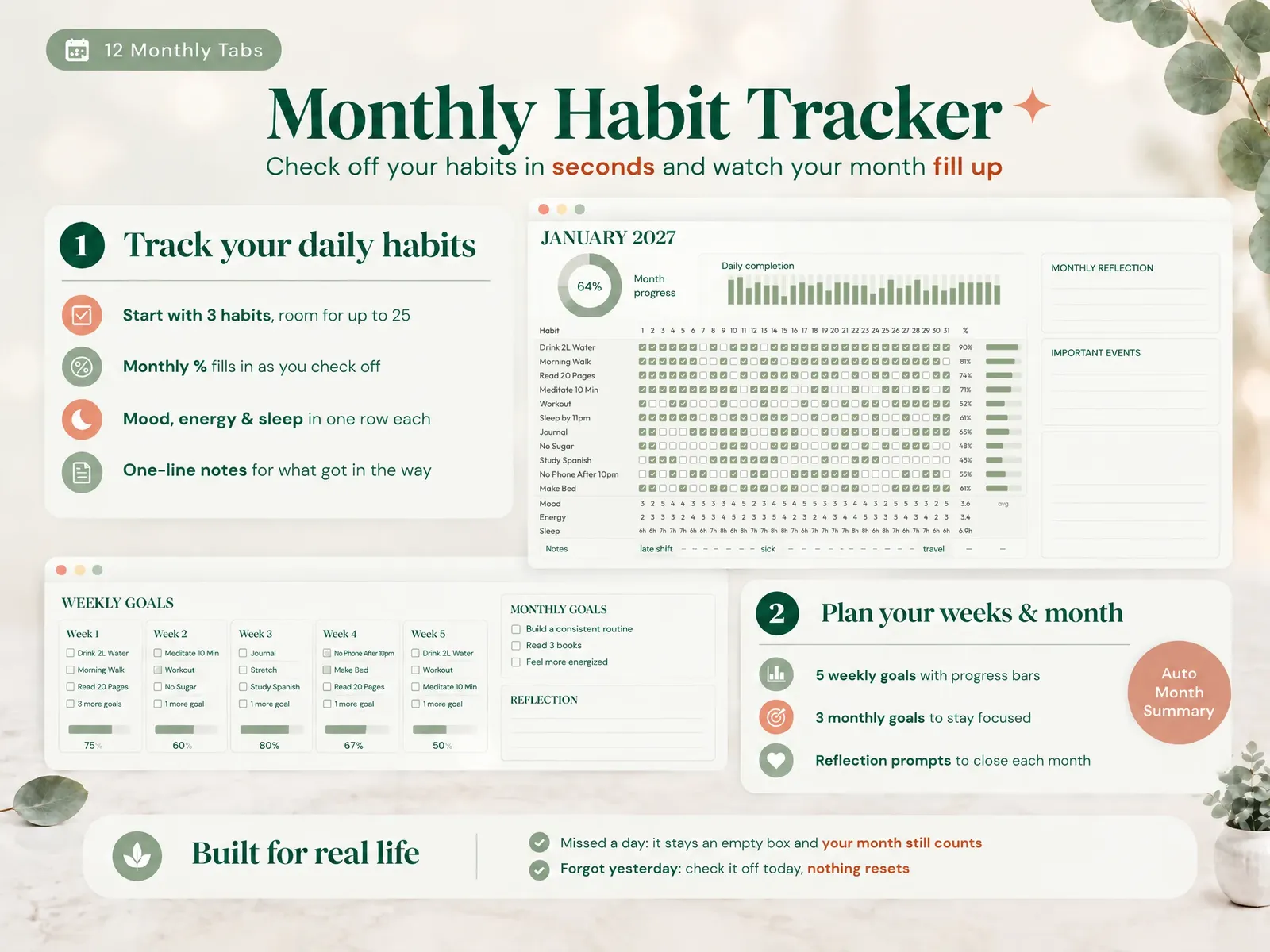
The Ultimate Habit Tracker (ultimatehabittracker.site) is the month grid from this post, already built. It has 21 tabs in 4 sections, with a monthly checkbox grid for up to 25 habits, and Excel and Google Sheets copies are both included. You check off a habit in seconds with no typing, and the monthly percentage updates automatically.
A missed day pauses your streak instead of resetting it, a forgotten day can be filled in later, and comebacks are counted. A dashboard shows the month, and a year in review is automatic. Each monthly tab also has a one-line notes field, where you can write the cue, routine and reward for a habit.
It does not send reminders, by design, so the cue has to come from your own routine. You pay $9 once and reuse it every year. You can see every tab in the habit tracker spreadsheet for Excel and Google Sheets before you decide.
Frequently asked questions
What does cue mean in Atomic Habits?
In Atomic Habits, James Clear describes a cue as the trigger that starts a habit. It is the first of his four steps: cue, craving, response and reward. Charles Duhigg's earlier book The Power of Habit uses three steps: cue, routine and reward. Both describe the same loop.
What are the three parts of the habit loop?
A cue, a routine and a reward. The cue is the trigger, such as putting the kettle on. The routine is what you do, such as reading 10 pages. The reward is what you get, such as a finished chapter or a few quiet minutes.
What are ten good habits to track?
Common picks are a short walk, reading 10 pages, a glass of water with each meal, a set bedtime, phone off by 10pm, stretching, a weekly review, tidying one surface, writing one line in a journal and a fixed time for email. Start with three and add more only when those feel easy.
How long does a habit loop take to form?
It varies a lot. In the University College London study by Lally and colleagues, the average time to reach peak automaticity was 66 days, and individuals ranged from 18 days to a predicted 254. A single missed day had little impact on later gains.
What do I do when I miss a day?
Leave the box empty and do the routine the next day. One miss does not break the loop. Two in a row is the signal to make the routine smaller or move the cue.
Sources
- Singh, Murphy, Maher and Smith (2024), Time to Form a Habit: A Systematic Review and Meta-Analysis, Healthcare (Basel) 12(23):2488
- Google Docs Editors Help: Add & use checkboxes
- Microsoft Support: Using check boxes in Excel
- Lally, van Jaarsveld, Potts and Wardle (2010), How are habits formed: Modelling habit formation in the real world, European Journal of Social Psychology
- BPS Research Digest: How long does it take to form a habit? (on Lally et al., 2010)
- Charles Duhigg, The Power of Habit (Random House, 2012)
- James Clear, Atomic Habits (Avery, 2018): the habit loop
Keep reading
Habit Tracking
Habit Tracker Templates That Survive Week 3 (Matched to How You Track)
Habit tracker template checklist: 7 things a template needs to last past week 3, the formats compared on a missed day, and whether free or paid fits you.
· 8 min read
Habit Tracking
How to Track Habits in Google Sheets (Without Typing on Your Phone)
Habit tracker Google Sheets setup: a checkbox grid, a month score and a phone shortcut in four steps, plus what one missed day does to your streak.
· 8 min read
Habit Tracking
Habit Tracker Spreadsheet: How to Build One That Survives a Missed Day
Set up a habit tracker spreadsheet in Excel or Google Sheets that keeps counting after a missed day: the layout, formulas, streak rule and what to track.
· 9 min read
