Temptation Bundling: Pair a Habit With Something You Like
Temptation bundling pairs a task you want to do with a habit you want to build. Use these simple rules to make a pairing enjoyable and easy to repeat.
By Ultimate Habit Tracker by Cosmo Suite · Editorial policy
Published · 9 min read
You have a podcast queued for your commute and a pile of laundry waiting at home. Temptation bundling pairs the thing you want to do with the useful task you have been putting off. You might save a favorite show for folding clothes, or play an audiobook while you walk. The pairing makes the task more appealing in the moment.
It is a small experiment, not a promise that a habit will stick. The research tested one specific pairing with people who already wanted to exercise. Your useful action, your treat and your schedule all matter. Start with a pairing that feels natural, decide what a completed try looks like, and notice whether you still enjoy it after a few repetitions.
What temptation bundling means
Temptation bundling is the practice of pairing an immediately enjoyable activity with a useful activity that offers a later benefit. The idea is to make the useful task more attractive now by doing it alongside something you already want. It differs from an if-then plan, which connects a cue to an action. See the if-then habit examples for that approach.
The name comes from research by Katherine Milkman, Julia Minson and Kevin Volpp. Their field experiment paired audio novels, including The Hunger Games, with gym visits. Some participants could listen to the books only at the gym. Others received encouragement to reserve the books for workouts, while a control group had no audiobook access through the study. For how cues and routines work, see the habit loop guide.
That setup matters. This was not a test of every possible habit or every kind of reward. The participants were university community members who wanted to work out more. The researchers studied whether restricting a tempting activity to the gym could influence gym attendance. You can borrow the pairing idea without assuming that the study predicts what will happen in your routine.
A useful bundle has two parts: something you want now, and something you have already decided is worth doing. The enjoyable activity should fit the task. Music can go with cooking or tidying. A call with a friend may fit a walk. A favorite show may work with folding laundry, but not with a task that needs your full attention.
Temptation bundling at a Glance
The right pairing depends on whether the two activities can happen together and whether you would still choose the useful task without pressure.
| Useful activity | Enjoyable activity | Check before pairing |
|---|---|---|
| Walk | Favorite podcast or audiobook | Choose a safe route and keep awareness of traffic |
| Fold laundry | A show or comedy special | Save a program you actually want to watch |
| Cook a familiar meal | Music or a call | Avoid pairing that distracts from hot pans or knives |
| Tidy one room | A playlist | Set a small stopping point, such as one shelf |
| Stretch gently | An album or radio show | Follow guidance that fits your body and ability |
Try one pairing at a time. A bundle should make the useful task easier to start, not add equipment, cost or a complicated rule. If either part needs attention, choose a different combination. Safety and the task come before the treat.
What the study tested, and what it did not
The 2014 study included 226 participants who wanted to exercise. Researchers assigned them to conditions with gym-only audiobook access, encouragement to save the books for the gym, or no audiobook access through the study. They recorded gym visits over nine weeks.
The researchers reported that the gym-only audiobook group initially visited more often than the control group. Attendance declined over time, particularly around a natural break in gym access. At the study's end, 61% of participants in the restrictive-bundle group chose to pay for continued gym-only access to the audiobooks. Those are findings from that study's sample and setting, not a general estimate for all habits.
A later field experiment tested teaching gym members to pair an audiobook with exercise while giving them access to one. It reported a 10–14% increase in the likelihood of a weekly gym visit during and up to 17 weeks after a four-week intervention, compared with the control group. The 2020 study involved an exercise program, so its result still does not predict what will happen with a different task or reward.
The study does not establish that listening to anything while doing a task will increase consistency. Participants already wanted to exercise, and the study focused on a specific reward and setting. It also does not show that you need to restrict access to your favorite activity. You can test a softer version, such as choosing a playlist for a walk, and see whether it changes how the walk feels to you.
There is another practical limit: a bundle can lose its appeal. The audio novel was enjoyable partly because participants wanted it. If the pairing turns a favorite activity into an obligation, it may stop feeling rewarding. The researchers also raised the question of how bundles hold up over time and after breaks. A missed day or interrupted week is a reason to review the pairing, not evidence that you lack discipline.
How to make a pairing you will want to repeat
Use these steps to build a bundle around a task you chose:
- Choose the useful action. Pick a small version you can recognize, such as walking around the block or clearing one counter. “Exercise more” is too broad for a first trial.
- Pick an enjoyable companion. List simple things you already like: a playlist, podcast, call, comfortable drink or familiar show. You do not need to buy anything.
- Check that they fit safely. A treat that demands your attention can make a task harder or unsafe. Save a show for folding clothes, not for crossing busy streets. A call may suit a familiar walk, but not a route where you need to hear traffic.
- Try the pairing without making it a rule. You might save one podcast for walks, but you can still walk without it. The bundle should make starting more attractive, not turn pleasure into payment or create a penalty for missing a session.
Test the pairing in ordinary conditions. It should not require a perfect hour or special setup before you can begin.
After a few tries, ask three questions: Did I want the enjoyable activity? Did it fit the useful task? Would I choose this pairing again? If the answer to the last question is no, swap one part. If the useful activity still feels too large, make that part smaller instead of adding a bigger reward.
Use a three-part fit check before keeping a bundle: want (do you look forward to the enjoyable activity?), fit (can both activities happen safely at once?), and repeat (would you choose this combination again on an ordinary day?). A pairing that fails any one check needs an edit. Change the task, choose another treat or drop the bundle. This is a practical decision rule for your own trial, not a formula tested by the study.
A sample week of bundles
Here is an illustrative plan for someone who wants to walk more and keep up with a small home task. It is an example, not data from a study or a real person's tracking.
| Day | Useful activity | Pairing | What to record |
|---|---|---|---|
| Monday | Walk for 10 minutes | Listen to a familiar podcast | Walk completed; pairing felt enjoyable |
| Tuesday | Fold a small load of laundry | Watch one saved show | Laundry completed; show still felt like a treat |
| Wednesday | Walk for 10 minutes | Continue the podcast | Walk completed; note if the route felt safe |
| Thursday | Clear one shelf | Play a favorite album | Shelf cleared; music fit the task |
| Friday | Walk for 10 minutes | Call a friend, if convenient | Walk completed; call was optional |
| Saturday | Choose one task from the week | Repeat the best fit | Which pairing would you keep? |
| Sunday | No planned task | Rest or choose freely | No box needs to be filled |
The record is deliberately short. You could mark whether the useful action happened and whether the pairing felt worth repeating. Do not treat a missed session as a failure or infer that the treat caused a completed task. The note helps you decide whether to keep, change or drop the combination.
If you try a bundle and skip the activity, look for a practical reason. Perhaps the time was wrong, the task was too big, or the enjoyable part did not fit. You can move the activity, shorten it or choose another pairing. The record is useful only if it helps you make a decision.
When a bundle is a poor fit
Skip a pairing when it makes the task unsafe, harder to focus on or dependent on spending money. Do not pair a treat with work that requires attention to traffic, cooking hazards, machinery or another person's needs. Choose an activity that fits your circumstances and any professional guidance you already follow.
A bundle may also be a poor fit when the useful task is unclear. If you do not know what counts as “done,” a reward will not solve that problem. Write a small action first. You can also use an if-then plan, such as, “When I finish lunch, I will put on my walking shoes.” That gives the action a cue; temptation bundling gives it a companion activity.
Most of all, do not make pleasure something you have to earn. If a favorite show or song matters to you, it is fine to enjoy it without completing a task. The bundle is an option you can use when it helps, not a contract you must keep.
What to track about the pairing
Track the useful action and the pairing as separate observations. For example, record whether you walked, whether you listened to the podcast, and whether you would pair them again. This makes it easier to spot the difference between a task that fits and a treat that does not.
Use a small sample rather than a complicated score. If you tried a pairing four times and liked it twice, that is enough information to ask what changed. Maybe the route was pleasant on one day and crowded on another. Maybe the podcast was interesting at first and then became a distraction. A simple note keeps the choice grounded in what you noticed.
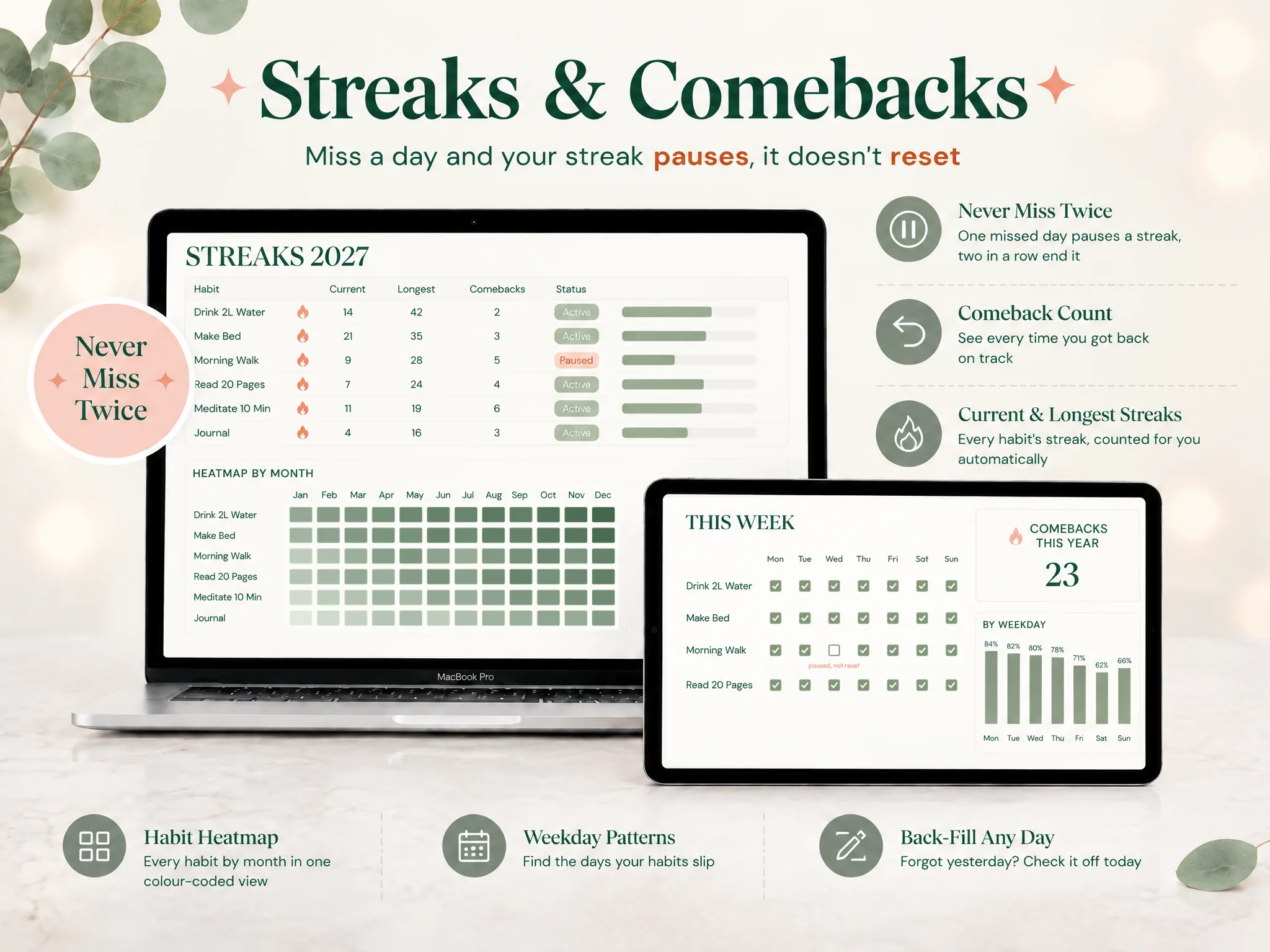
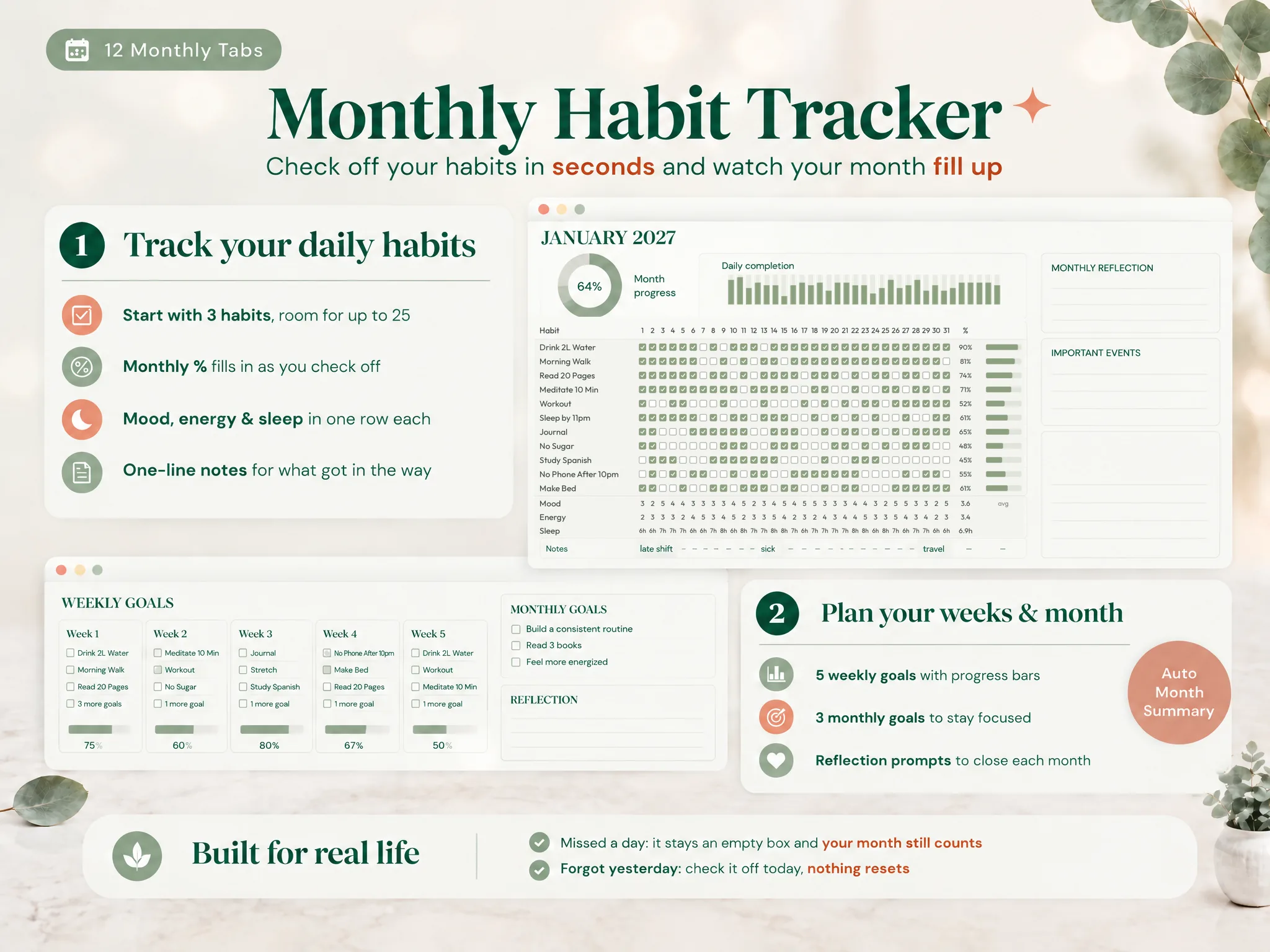
A monthly grid can help you see when you checked off an action and when you skipped it. If you prefer keeping the record in one file, the Ultimate Habit Tracker includes monthly trackers and reflection prompts. The tracker overview explains its tabs; it is a spreadsheet for recording habits, not an app that sends reminders or chooses rewards for you.
A month score describes the boxes you marked. It does not explain why a pairing did or did not suit you. Add a short note when you want context, then use that context to decide whether the bundle stays in your routine. The measure is a prompt for a review, not a grade on your character.
Where the Ultimate Habit Tracker fits
A bundle is easier to evaluate when you can remember what you tried. The Ultimate Habit Tracker has 12 monthly checkbox grids, reflection prompts and a Streaks & Comebacks tab. You can record a habit, note a missed day and look back at the month without treating one empty box as a reset.
The spreadsheet includes Excel and Google Sheets versions, and it does not send notifications. You still choose the pairing, decide what counts as a completed action and make any changes. The Streaks & Comebacks tab shows how the spreadsheet records streaks and returns after a miss. If a paper note or a blank calendar works better for you, use that. The useful part is having a record you will actually return to.
See the Ultimate Habit Tracker to check whether its monthly grid fits how you like to track. The file records check-offs; your own notes tell you whether the podcast, music or other pairing made the task more appealing.
Why trust this article
We are the Cosmo Suite team that built the Ultimate Habit Tracker spreadsheet. Our editorial team checked the study details against the linked research papers on October 22, 2026. The sample week above is illustrative. Verify study details before applying them to a different setting.
Read more about the team and its editorial policy or contact us with a question about this article.
Frequently asked questions
What is temptation bundling?
Temptation bundling means pairing an activity you enjoy right now with a useful action you want to do. For example, you might listen to a favorite podcast while folding laundry. The pairing can make the useful action more appealing, but it does not guarantee that you will repeat it.
How do I try temptation bundling?
Choose one activity you already want to do and one habit you have chosen for yourself. Pair them in a way that fits the task, then try the combination a few times. Keep it only if both parts still feel worthwhile and the pairing is practical.
Can I bundle two habits together?
Yes, if one activity makes the other easier or more enjoyable. You could listen to music while tidying or call a friend while taking a walk. Keep the combination safe and practical, and avoid turning the enjoyable activity into a reward you must earn.
Does temptation bundling work for everyone?
No single pairing works for everyone. A field study tested audiobook access during gym visits with people who already wanted to exercise. Your task, preferences, schedule and circumstances may differ, so treat a bundle as an experiment rather than a proven fix for every habit.
How long should I try a bundle?
Try it long enough to notice whether the pairing fits your ordinary week, then review what happened. There is no research-backed number of days that guarantees a habit will stick. If the enjoyable activity loses its appeal or the task becomes harder, change or stop the pairing.
What is the difference between temptation bundling and habit stacking?
Temptation bundling pairs a wanted activity with a useful task, such as an audiobook with a walk. Habit stacking connects one action to an existing cue, such as stretching after you brush your teeth. One emphasizes enjoyment; the other emphasizes when to act.
What is one easy example to try this week?
Pick a task and an enjoyable activity that can happen at the same time. For example, play a playlist while you prepare tomorrow's lunch. Decide what counts as a completed session, try it without pressure, and keep a simple record of whether the pairing suited you.
Sources
- Milkman, Minson and Volpp (2014), Holding the Hunger Games Hostage at the Gym: An Evaluation of Temptation Bundling, Management Science
- Milkman, Minson and Volpp (2014), full text, PubMed Central
- Milkman, Minson and Volpp (2014), study summary, Penn Today
- Kirgios et al. (2020), Teaching Temptation Bundling to Boost Exercise: A Field Experiment, Organizational Behavior and Human Decision Processes