Free Habit Scorecard Template: Copy & Customize (2026)
Habit scorecard template to list daily habits, mark them in context, and turn a two-week review into three actions you can track in a simple monthly grid.
By Ultimate Habit Tracker by Cosmo Suite · Editorial policy
Published · 8 min read
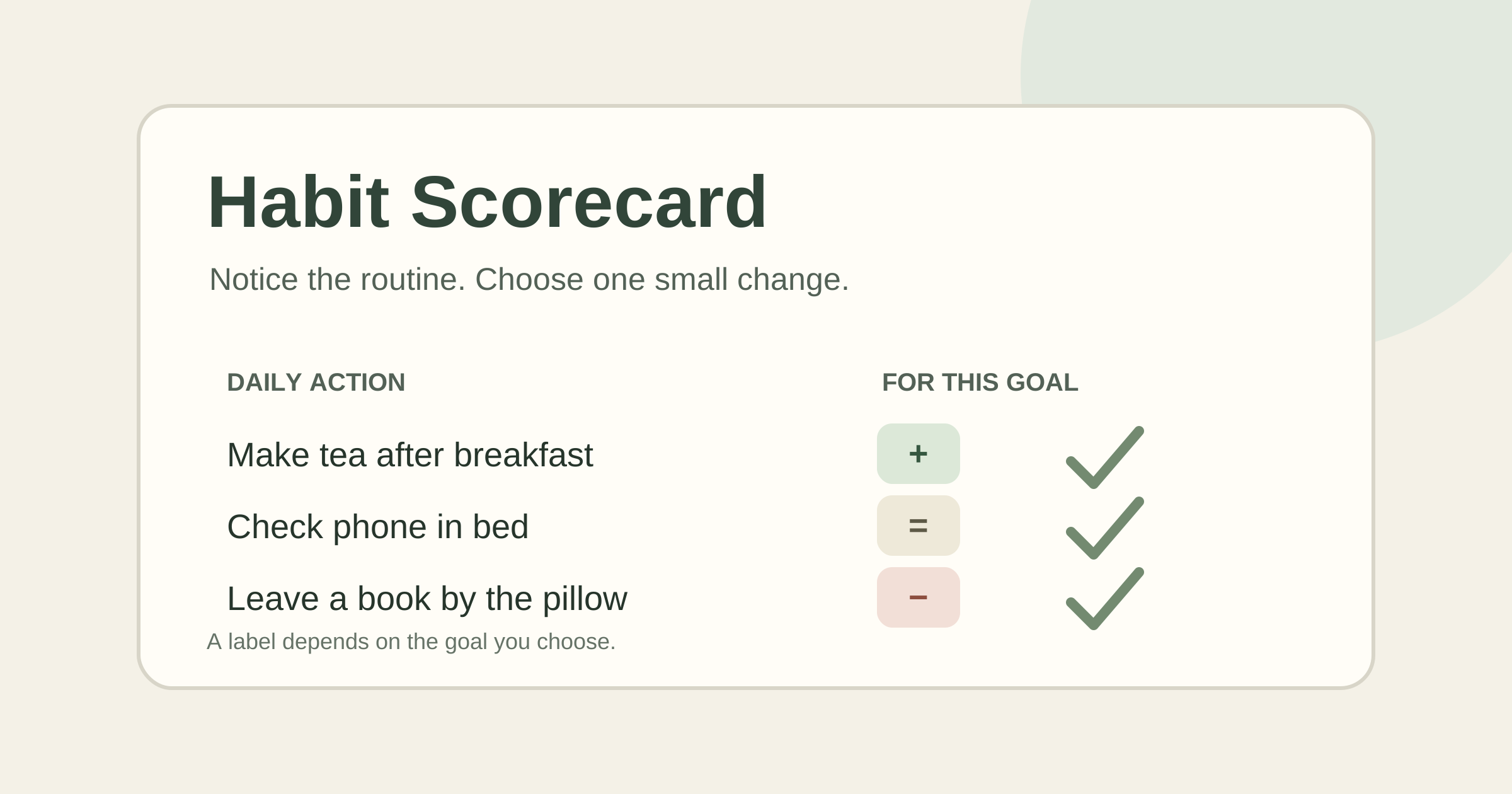
A habit scorecard is a list of the actions you already do, marked against one goal so you can choose what to change with less guesswork. If you have ever planned a fresh routine, missed a day, and decided the whole week was gone, start by observing your ordinary day before adding another rule.
Here, you will mark actions against one goal, then use a two-week review to choose three small behaviors to track. Two weeks is a useful window for noticing a routine, not a habit-formation deadline. In a 2010 study, Lally and colleagues asked volunteers to repeat a chosen behavior in the same context for 12 weeks and record it (Lally et al., 2010). The shorter window in this guide helps you choose a next step. It does not show that a habit has formed. A habit tracker can record that next step and leave a missed day as an empty box without resetting the month.
What a Missed Day Does to Your Score
A missed day still belongs in the record. The scorecard describes a pattern of actions; it does not rate whether you had a perfect run. If you forget to write down a day, leave it blank and continue when you remember.
The scorecard and the tracker have separate jobs. The scorecard helps you notice what happens and whether it fits a goal. A tracker records a chosen action over days or weeks. If you treat the scorecard like a pass-or-fail streak, you may be tempted to tidy up the record. Keep the ordinary disruptions in view.
If you want a simple way to capture completed actions after this review, a habit tracker spreadsheet that keeps the month visible after a missed day gives each day its own checkbox. The review and the tracker have different jobs: one helps you decide what to practice, and the other records whether you did it.
Habit Scorecard at a Glance
Use the scorecard to choose what may be worth changing, then use a tracker to record that action. A short journal can help when the pattern is unclear.
| Tool | What you record | Best for |
|---|---|---|
| Habit scorecard | Existing actions, marked against one goal | Finding a routine to adjust |
| Habit tracker | Whether a chosen action happened | Seeing follow-through over time |
| Short journal | Context around a specific day | Understanding why a plan fit or did not |
James Clear's Habits Scorecard exercise starts with a list of daily actions. It marks each as positive, neutral, or negative according to the goal in view. The labels describe fit, not a person's character. An action may help one goal and work against another.
Start with one goal
Before making marks, write one plain goal at the top of the page. “I want calmer mornings” is easier to use than “I should be better.” Your goal gives each symbol a reference point. Without it, “good” and “bad” can turn into vague labels for ordinary choices.
Build a Habit Scorecard in 14 Days
Two weeks gives you a chance to see different kinds of days. Use a notebook, a notes app, or a blank spreadsheet. Keep the record short so it does not become another project.
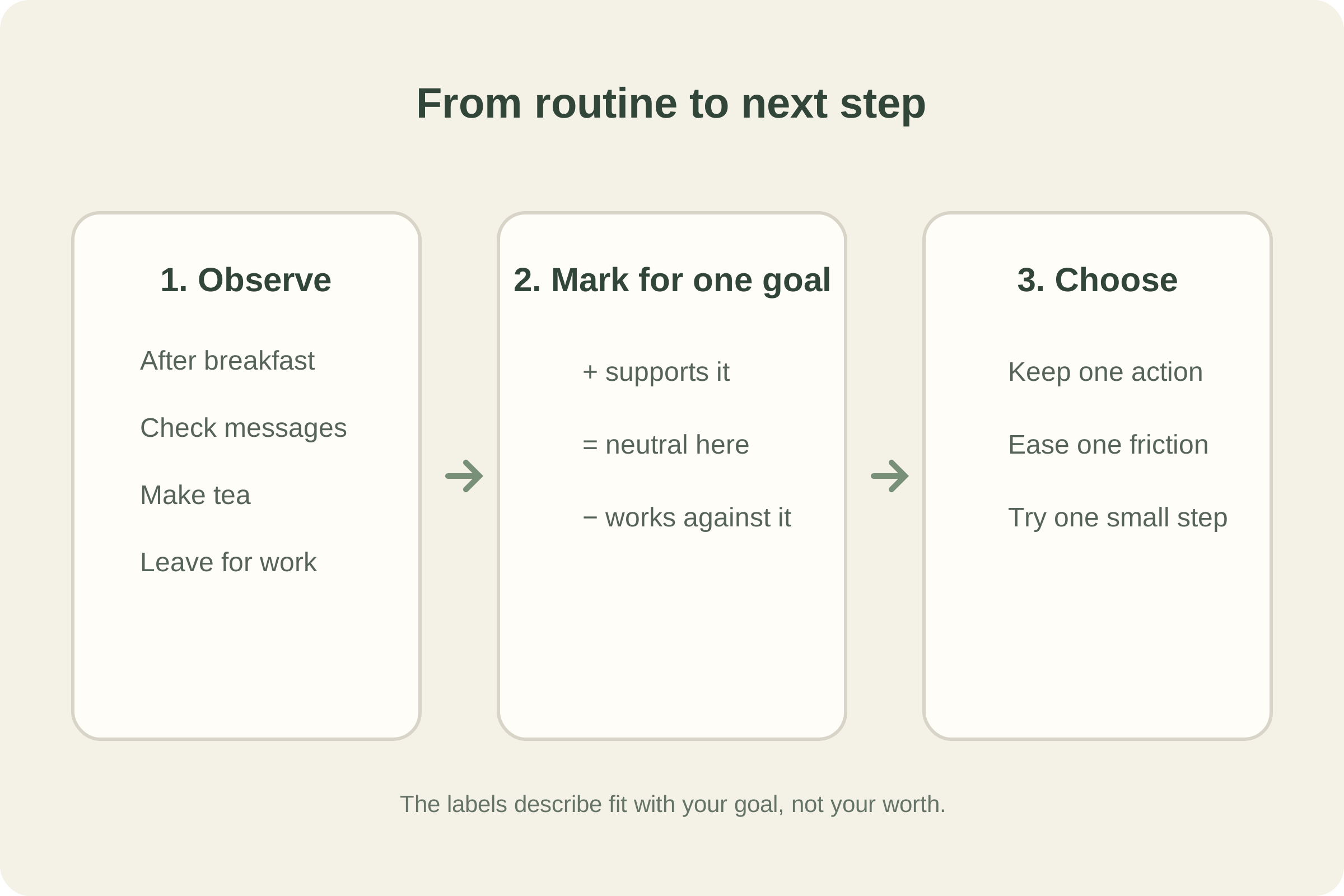
- Write actions in sequence. Start with the first hour of your day and add familiar actions in order: silence the alarm, check messages, make coffee, get dressed, leave home. Add evening actions later. Describe what you do, not what you think you should do.
- Notice the cue and friction. Add a few words when they help: “after breakfast,” “phone within reach,” or “bag already packed.” These details can show where an action fits or where a plan gets awkward.
- Mark each action against your goal. Use + for a behavior that supports the goal, = for one that is neutral, and - for one that works against it. James Clear's article uses these symbols and notes that the same action can mean different things for different goals.
- Leave uncertain items unmarked. You do not need to force a category. Add a question mark or revisit the line after a few more ordinary days.
- Review the list once at the end. Circle one item to keep, one to make easier, and one small action to test. You are looking for a useful next step, not a perfect score.
You can repeat the review after a missed day. Record what happened if you remember, then carry on. A blank entry is more honest than filling it in from a guess.
A Two-Week Example
The example below is fictional. It shows how an ordinary observation can lead to a small adjustment; it is not customer research or a tested result.
Imagine your goal is to read before bed. During two weeks, you notice a few actions around that moment. You also count how many days each action appeared, only to help choose where to start.
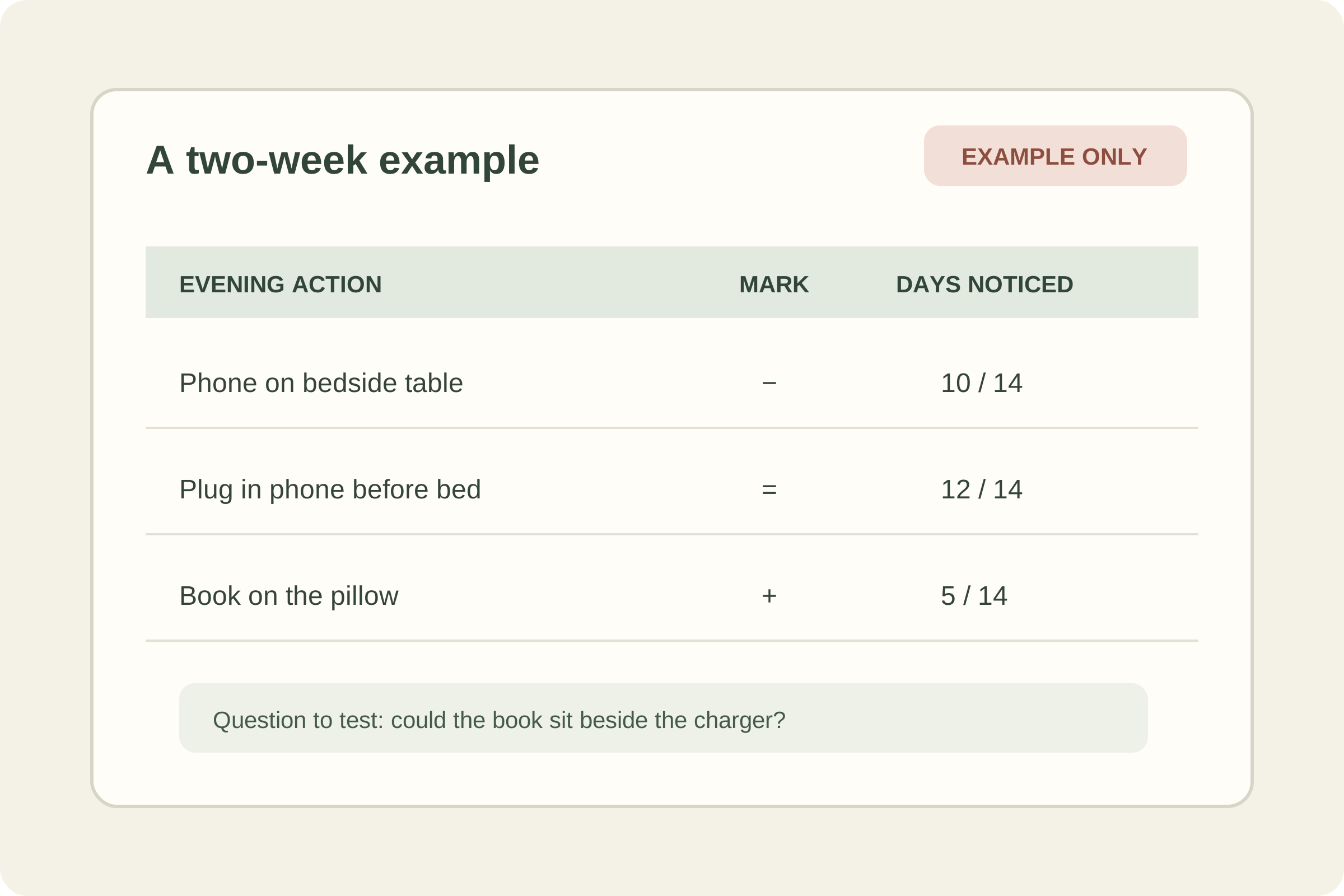
| Observed action | Mark for the reading goal | Days noticed in this example | What the note suggests |
|---|---|---|---|
| Put phone on the bedside table | - | 10 of 14 | The phone is within easy reach |
| Plug in phone before getting into bed | = | 12 of 14 | This is part of the existing routine |
| Leave a book on the pillow | + | 5 of 14 | The cue was present on some evenings |
The counts are not a grade and do not prove why reading happened. They are a prompt for a useful question: could the book be placed beside the charger so it is easier to see before bed? That changes the setup without asking you to overhaul the evening.
Original analysis: Read each line in two parts: the action itself and the moment around it. The minus mark points to an action you want to reduce for this goal. The note about the phone being within reach suggests a possible place to change the setup. Those are separate observations. Moving the phone may help, or it may not fit your evenings; a later tracker can tell you whether you followed the new plan, while the scorecard cannot predict what will happen.
A different person may label the same actions differently. Someone trying to keep a phone available for family calls may not want to move it away. Use your own aim and constraints to choose the labels.
For a broader set of starting ideas, see habits to track by goal. Pick only the rows that match your life. A long list is not more useful if you stop opening it.
Turn the Review Into Three Trackable Actions
The scorecard is finished when it helps you choose what to try next. Keep the next step specific enough to check off, and small enough to fit a day that does not go to plan.
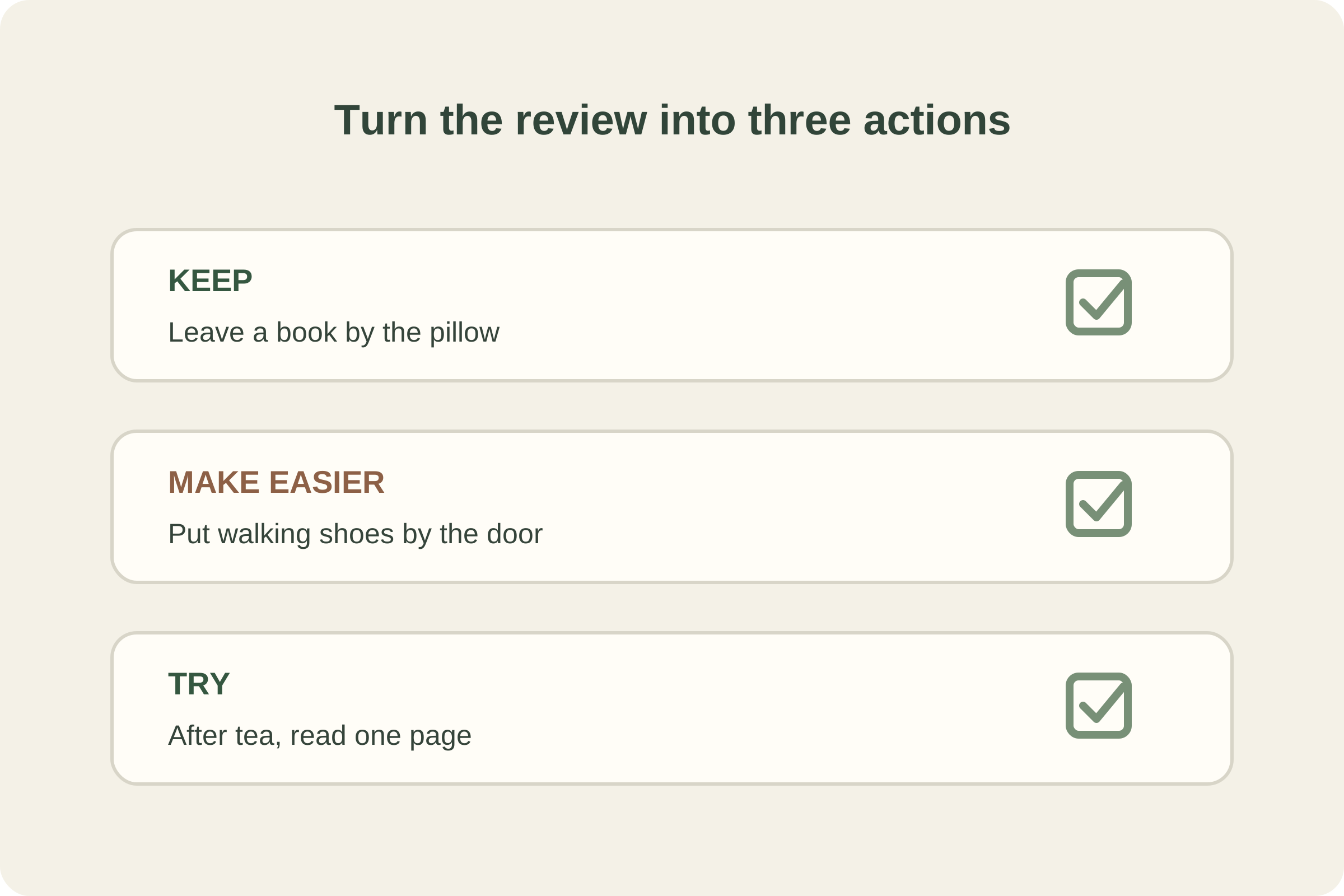
- Keep one helpful action. If laying a book on the pillow supports your goal, make that a checkbox or a note in your routine.
- Reduce one point of friction. If your running shoes stay in a closet, move them where you get dressed. The action is “put shoes by the door,” not “become a runner.”
- Add one small behavior. Choose a clear action with a cue: “After I make tea, I will read one page.” If the cue changes, adjust the plan rather than judging yourself.
Each tracker row should name a behavior you can recognize. “Be healthier” is hard to check off. “Take a short walk after lunch” tells you what counts. A ready-made habit tracker spreadsheet can record those check-offs and keep the monthly view in place. For more on separating the daily check-off from the monthly view, see how to build a habit tracker spreadsheet.
A written progress record can help people act on a goal, but it cannot supply time, interest, support, or a workable plan by itself. Harkin and colleagues' 2016 meta-analysis included 138 studies and 19,951 participants in interventions designed to promote monitoring of goal progress. The authors found that these interventions increased monitoring and goal attainment on average (Harkin et al., 2016). That is evidence about the interventions studied, not a promise about this scorecard or your next habit. The review covered different goals and monitoring interventions. It did not test this article’s two-week exercise. Read the PubMed record for the progress-monitoring meta-analysis or the full APA paper for its methods and limits.
What a Habit Scorecard Can and Cannot Tell You
A scorecard can show which actions repeat, what tends to happen before them, and which small change you want to test. It cannot tell you that an action is universally good or bad, diagnose a condition, or prove that one cue caused a result.
Keep the labels specific to your goal. If you want to read more, checking a message first may be a minus in that context. If your goal is to respond to an urgent family message, that same action may be useful. Write down what you mean so the symbols remain practical.
The scorecard also does not need to become a permanent daily form. Once you know what you want to practice, you can keep the short list and track only the chosen actions. Review after a week or two if the plan feels awkward, or when your schedule changes. There is no universal review interval.
Why Trust This Article
The Cosmo Suite team makes the Ultimate Habit Tracker, so we have a stake in spreadsheets and are not neutral about that product. The scorecard method here is described in James Clear's published article, and the research context comes from Harkin et al. (2016), linked above. We apply those sources to a practical example; we do not claim to have tested this exercise with readers. The two-week window is our suggested way to gather a little context and does not come from either study. Learn more about Cosmo Suite and the site and how the blog is made in the editorial policy. For corrections, use the contact details on the About page.
Where the Ultimate Habit Tracker Fits
The Ultimate Habit Tracker (ultimatehabittracker.site) is a spreadsheet for recording chosen habits in Excel or Google Sheets. It includes 12 monthly check-box grids, a month percentage, streaks and comebacks, and a year view. It costs $9 once, according to the product's published contents and price. It does not send reminders or notifications.
If you have finished the scorecard and want a ready-made place to check off your next actions, the Ultimate Habit Tracker monthly spreadsheet can hold those rows and show the month even after an empty day. It is useful if you want the formulas and yearly layout already prepared. A simple paper list or a spreadsheet you make yourself may suit you better if you only need a few rows.
Start with the three actions that came from your review. Give each one a clear cue, check it off when it happens, and leave the box empty when it does not. When you come back to the scorecard, use what you observed to adjust the plan.
Frequently asked questions
What is a habit scorecard?
A habit scorecard is a list of everyday actions marked in relation to a goal. James Clear's version uses a plus for a helpful habit, a minus for one that works against the goal, and an equals sign for a neutral one.
How do I make a habit scorecard?
Write down the actions in a normal day in the order they happen. Pick one goal, then mark each action as supportive, neutral, or worth changing in that context. Review the list before choosing a small next step.
How many days should I use a habit scorecard?
There is no required number of days. This guide uses two weeks as a practical observation window so you can notice ordinary variation. It is a suggested exercise, not a validated deadline or guarantee.
What should I do after I finish a habit scorecard?
Choose one action to keep, one friction point to reduce, and one small behavior to add. Write each as something you can check off, then review whether the plan fits your real schedule.
Does missing a day ruin a habit scorecard?
No. A scorecard describes habits and context; it is not a streak or a grade. Leave a missed check-off empty and use it as one detail in the review, without treating it as proof that you failed.
Is a habit scorecard the same as a habit tracker?
A scorecard helps you notice and classify behaviors. A habit tracker records whether you completed a chosen action over time. You can use the scorecard first, then track only the actions you decide to practice.
Does habit tracking guarantee a behavior will change?
No. Harkin and colleagues' 2016 meta-analysis found that progress-monitoring interventions increased monitoring and goal attainment on average, but that does not guarantee an outcome for one person or one habit.
Sources
- James Clear, The Habits Scorecard: Use This Simple Exercise to Discover Which Habits You Should Change
- Harkin et al. (2016), Does Monitoring Goal Progress Promote Goal Attainment? A Meta-Analysis of the Experimental Evidence, Psychological Bulletin
- Lally et al. (2010), How Are Habits Formed: Modelling Habit Formation in the Real World, European Journal of Social Psychology
