How to Track New Year Resolutions (Without Quitting by February)
New year resolution tracker: turn five resolutions into three weekly habits, score each month by the days you showed up, and plan for February before it hits.
By Ultimate Habit Tracker by Cosmo Suite · Editorial policy
Published · 8 min read
You write five resolutions on January 1 and check off every box for a week. By mid-February one of them has become a chore, two have quietly stopped, and the sheet you built for them is a tab you avoid opening. That is the usual path of a new year resolution tracker, and it rarely ends because you stopped caring.
A new year resolution tracker is a record of the small actions behind your resolutions, checked off daily and reviewed monthly. The short answer for making one last: track fewer things, in smaller pieces, and score the month instead of the streak. Turn each resolution into one small action, start with three, and let a missed day be an empty box. A habit tracker spreadsheet that keeps counting the month after a missed day handles the scoring, and the rest of this guide covers the setup.
What a Missed Day Does to a Resolution
A missed day ends more resolutions than a lack of interest does, because most trackers treat it as a reset. The record says zero, and zero reads like a verdict.
The research on resolutions points the other way. Norcross and colleagues followed 159 resolvers for six months. About three quarters were still going after one week, and 46% were continuously successful at six months, against 4% of comparable people who wanted to change but made no resolution. So resolving helps. The hard part is the long middle, when the novelty is gone and one bad day makes the whole plan look broken.
Habit research on missed days is also kinder than a streak counter. In the Lally study at University College London, a single missed opportunity did not materially affect the habit-formation process. That is the idea behind the never miss twice rule: one empty box is normal, and two in a row is the signal to restart today.
New Year Resolution Tracker at a Glance
Paper, apps, goal planners and spreadsheets all work for some people. They break in different places, so pick by where you have broken before.
| Format | What it records | Where it breaks | Best for |
|---|---|---|---|
| Resolution list on paper | The goals, once | Nothing prompts a daily or weekly check | Writing the list in the first place |
| Habit app | Daily check-offs and streaks | A reset after one miss; some features sit behind a subscription | People who want reminders |
| Goal planner template | Goals and milestones | Often has no daily record | Planning the year in one sitting |
| Habit tracker spreadsheet | Daily check-offs, month scores, patterns | Typing into cells, unless the layout is ready | People who want to own the file |
Most of the roundups on page one for this topic are lists of apps. They are fair for choosing an app. Google's own overview of the topic adds that a tracker should break annual goals into measurable steps and be checked weekly or monthly, which is the job of the sheet below.
Turn Five Resolutions Into Three Weekly Habits
A resolution is a direction. A habit is an action you can check off today. The conversion is where most trackers go wrong, because "get fit" has no box to check.
Take five invented resolutions and write each as the smallest daily action that still counts:
- Get fit: walk 20 minutes after lunch.
- Read more: read 10 pages before bed.
- Sleep better: phone off by 10 pm.
- Learn Spanish: parked until April.
- Drink more water: parked until April.
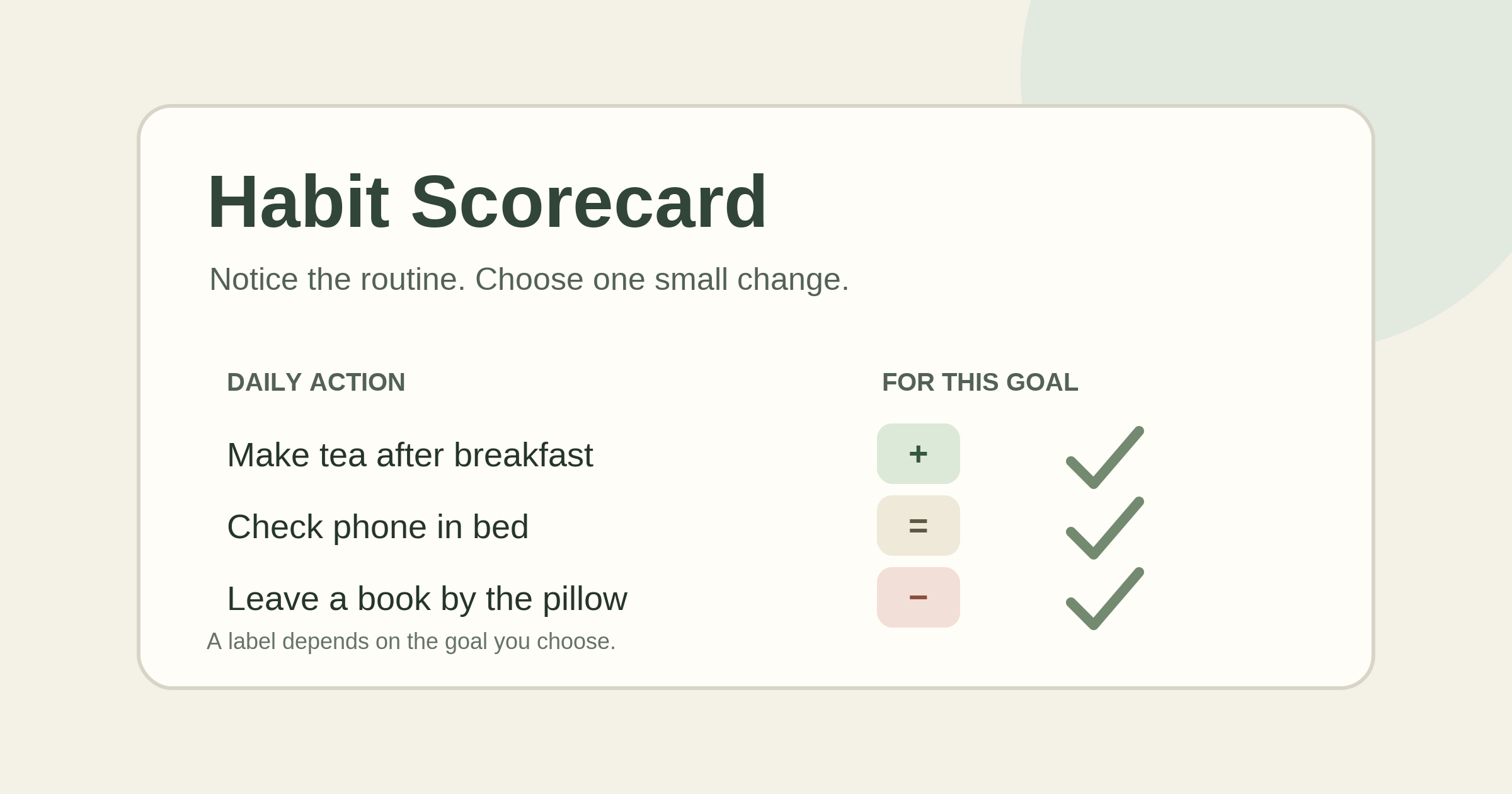
Three go into the tracker and two wait in a list. Each habit costs a few seconds a day to check off, and three habits are 93 boxes in a 31-day month. Five would be 155, and the sheet would start to feel like admin by week three. Our guide to what to track in a habit tracker has more starting ideas, and a habit scorecard helps if you are unsure which habits you already have.
Setting this up takes about 15 minutes:
- Write every resolution you care about, even the vague ones.
- Next to each, write the smallest action you could finish in under five minutes.
- Choose a target for the week, such as 5 days out of 7. A target below 7 leaves room for a normal week.
- Add one line on why it matters to you. You will want it in February.
- Put the monthly review in your calendar now, before the first box is checked.
The target in step 3 matters more than it looks. A habit you plan to do 5 days a week can miss 2 days and still hit its target, so a bad Tuesday is already inside the plan.
A Worked First Quarter: January, February, March
Here is the example that matters, an invented first quarter for the three habits above. It is made up to show the arithmetic, not a result from real users.
| Month | Boxes | Checked | Empty | Month score |
|---|---|---|---|---|
| January | 93 | 78 | 15 | 84% |
| February | 84 | 51 | 33 | 61% |
| March | 93 | 70 | 23 | 75% |
| Quarter | 270 | 199 | 71 | 74% |
February is the month that kills most resolutions. In this example a flu week and a short trip leave 33 empty boxes, and the score drops to 61%. A streak counter would have shown zero somewhere in the second week of February, and many people stop there.
The month score tells a different story. February is the low point, March climbs back to 75%, and the quarter lands at 74%. The comeback is part of the record, and you can see it on one screen.

Review Once a Month, Not Every Day
A monthly review is the cheapest part of the system and the one most people skip. A 2016 meta-analysis of 138 studies found that monitoring goal progress promoted goal attainment, and it worked better when progress was physically recorded. Writing the check-off down is part of the method.
Pick one fixed day, such as the first Sunday of the month, and ask three questions:
- Which habit scored under 60%, and was the target too big?
- Which habit scored over 85%, and can it become a bit harder?
- Is any habit one you no longer care about, so you can park it without guilt?
Shrinking a target is a decision, not a failure. Walk 20 minutes becomes walk 10, and the box is easy to check again. A resolution that scores 61% at half the size is doing more for you than one that scores 0% at full size.
Apply the questions to the example quarter. In February the walk habit would be the one to shrink, because it took the most hits from the flu week and the trip. In March it can grow back to 20 minutes once the box feels easy again. The same review works for any monthly layout, as long as each month gets its own score.
Write one line under the grid when you finish: what got in the way, and what you will change next month. A note like "late meetings made the evening habit hard, so move it to the morning" turns a low score into a plan, and it gives next month's review something real to read.

What Actually Keeps a Resolution Going Past February
Three choices decide whether a resolution survives the dip.
- Keep three habits until they feel automatic. The Lally study found an average of 66 days to reach automaticity, with a range from 18 to a predicted 254. Adding habits before day 60 resets that clock.
- Fill in a forgotten day later. If you did the walk and forgot to check the box, add it tomorrow. Honest records matter more than perfect timing.
- Make the first empty box ordinary. Decide now that one miss changes nothing and two in a row means you restart today. Then the first miss is a plan working.
A tracker that supports this is a spreadsheet where one miss pauses a streak and two end it, with the month score always visible. The sheet will not check boxes for you. What it does is keep a bad week on record, so the file is still worth opening.
Why Trust This Article
Cosmo Suite makes the Ultimate Habit Tracker, so it has an interest in describing the product well. The About page identifies the company, and the editorial policy explains how blog content is prepared. The statistics come from three named sources, listed at the end of the page and checked on 23 November 2026. Product details come from the published contents list.
The first-quarter example is invented to show the arithmetic. It does not describe any real person or a product test. The habit research is about averages, so check it against your own life before you act on it.
Where the Ultimate Habit Tracker Fits
The Ultimate Habit Tracker (ultimatehabittracker.site) is a spreadsheet with 21 tabs in Excel and Google Sheets, both included. You type your habits once in Setup, start with three and add up to 25, and they appear in all 12 monthly tabs. Each month has a daily checkbox grid, and the monthly percentage counts every day you showed up. One miss pauses a streak and two in a row end it, and a forgotten day can be filled in later.
For resolutions, the tabs that matter are Annual Goals and the Year in Review. Annual Goals holds up to 10 goals, each with a why and four quarterly milestones, linked to the habits behind them. The Year in Review is automatic, so the look-back in December needs no extra work. A habit tracker for your resolutions that you buy once for $9 has no reminders, by design, so a weekly review is the prompt that brings you back. Printable monthly and weekly pages come with it if you prefer paper.
Frequently asked questions
What is a new year resolution tracker?
It is a simple record of the small actions behind your resolutions. You list each resolution as a daily or weekly action, check it off when you do it, and review the totals once a month. It can be a spreadsheet, an app or a printed page. The format matters less than whether you keep opening it.
How many resolutions should I track?
Start with three. Each one needs a daily check-off, so every extra resolution adds work to your day. Three small habits are easy to finish in a minute. When they feel automatic, add a fourth. Park the rest in a list and revisit it next quarter.
What should I do when I miss a day?
Leave the box empty and check off today. One missed day barely changes a month, and a spreadsheet that scores the month keeps counting. The rule worth keeping is never miss twice in a row. If you only forgot to record yesterday, fill it in later.
How long does a resolution take to become a habit?
Longer than most people hope. In the University College London study by Lally and colleagues, the average was 66 days, and individuals ranged from 18 to a predicted 254. A single missed day did not make a lasting difference. Treat the first two months as practice, not a test.
Is a spreadsheet or an app better for resolutions?
It depends on what has stopped you before. An app is quick to start and can remind you. A spreadsheet is a file you own, with no subscription, and you can change any rule. If a broken streak made you quit before, a sheet that scores the whole month may suit you better.
Should I review my resolutions every month?
Yes, once a month is enough. Pick a fixed day, look at the month score for each habit, and decide to keep, shrink or park it. A 2016 meta-analysis found that monitoring progress helped goal attainment, and it helped more when the progress was physically recorded.
Sources
- Norcross, Mrykalo and Blagys (2002), Auld lang syne: success predictors, change processes, and self-reported outcomes of New Year's resolvers and nonresolvers, Journal of Clinical Psychology
- BPS Research Digest: How long does it take to form a habit? (on Lally et al., 2010)
- Harkin et al. (2016), Does Monitoring Goal Progress Promote Goal Attainment? A Meta-Analysis of the Experimental Evidence, Psychological Bulletin