Monthly Habit Tracker: Count the Month, Not Just the Streak
Monthly habit tracker: see how a monthly grid handles four missed days, what to record, and how to compare your completion rate with a streak.
By Ultimate Habit Tracker by Cosmo Suite · Editorial policy
Published · 8 min read
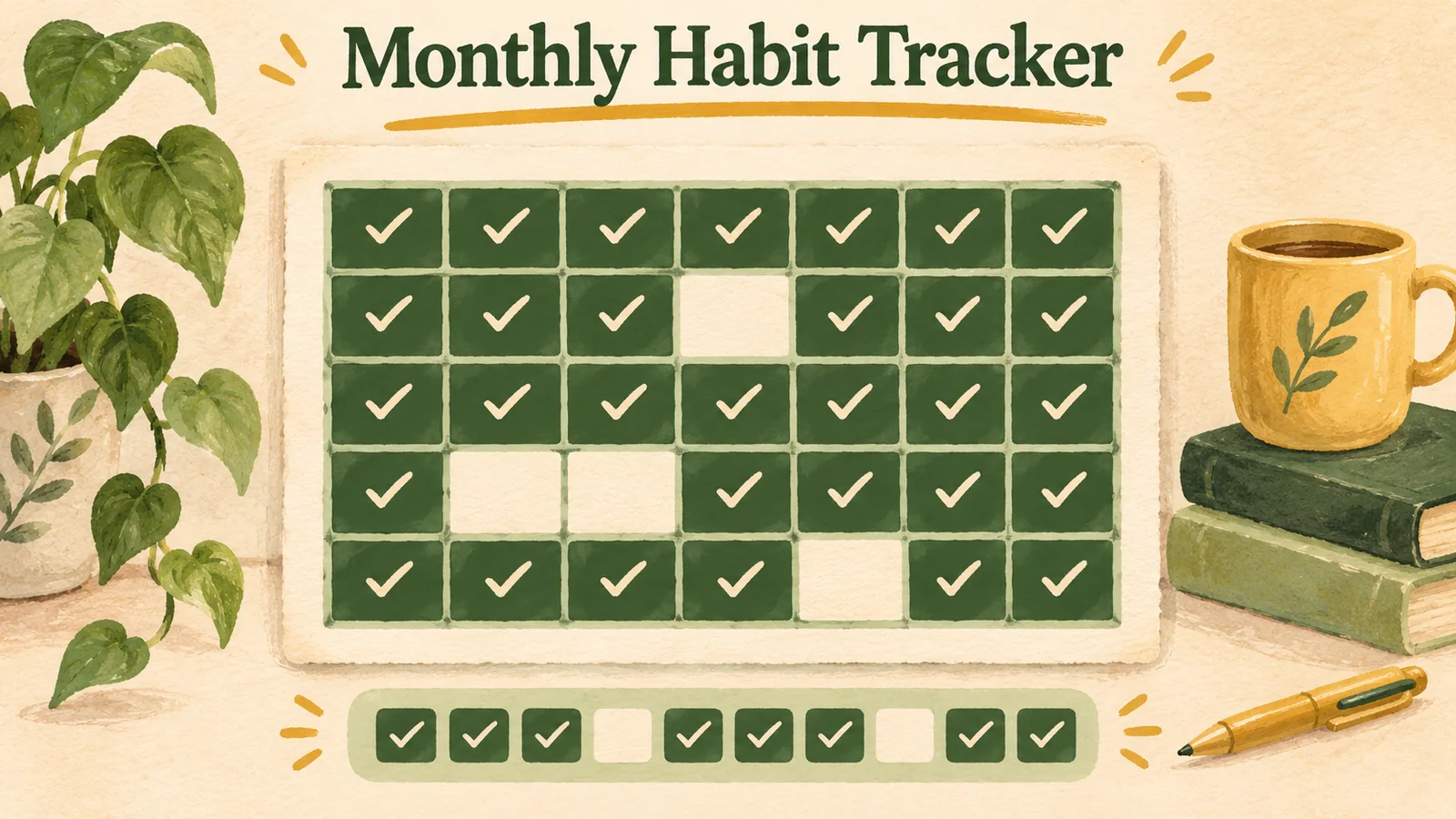
If you search for a monthly habit tracker, you probably want one page that makes progress easy to see. The usual grid gives every day a box, then turns the month into one long streak. Miss one day and the chain looks broken, even if you showed up most of the time.
A monthly tracker is more useful when it shows two scores: the share of planned days you completed and your current streak. In a fictional 30-day month with four missed days, that is 26 of 30 days, or about 87%, alongside the separate streak count. Here is how to set up the month, choose a fair denominator, and read both numbers without pretending they mean the same thing.
A monthly tracker should show a plan and a record
A monthly habit tracker is a calendar grid that records whether you completed a habit on the days you intended to do it. The plan tells you which days count. The record shows what happened. Keep those two ideas clear and the month stays readable after a busy week.
Start with one row per habit and one column per calendar day. Add a mark when you do the habit. If your plan is weekdays only, mark weekends as not planned rather than as missed. At the bottom, record completed planned days and the number of planned days. That gives you a completion rate with a denominator you can explain.
Some habits benefit from a small amount of context. A note such as “walked at lunch” can remind you what made a habit fit that day. Avoid turning the grid into a diary unless you want to review those details. The daily action should still take seconds to record.

Monthly habit tracker at a Glance
Use the tracker that matches the question you want answered. A streak emphasizes consecutive days. A monthly completion rate shows how often you completed the plan over the full period.
| Method | What it counts | What a missed day does | Best for |
|---|---|---|---|
| Calendar marks | Whether each planned day happened | Leaves a visible blank | Seeing patterns by date |
| Streak | Consecutive completed days | Pauses or ends the current run, depending on the rule | A daily chain that motivates you |
| Monthly rate | Completed planned days divided by planned days | Lowers the rate by one planned day | Seeing the whole month at once |
| Weekly total | Completed planned days within each week | Affects that week’s total | Spotting where the plan stopped fitting |
A streak and a monthly rate answer different questions. A 5-day streak can sit inside a month with many completed days, and a strong monthly rate can include a short streak. If the streak matters to you, keep it. Let the monthly total answer this: how often did I do what I planned?
For a related approach, see how a habit tracker spreadsheet can keep the month visible. That guide covers a wider spreadsheet layout; this page focuses on the monthly score. If you want a ready-made month grid, see the monthly tracker spreadsheet.
Calculate the percentage from planned days
Divide completed planned days by total planned days, then multiply by 100. For example, if a daily habit was completed on 26 of 30 planned days, the calculation is 26 ÷ 30 × 100 = 86.7%, which rounds to 87%.
This example is illustrative, not a product test or a promise about what any reader will achieve. Its purpose is to show why a calendar can give more context than a streak alone. The streak might be only 3 days, while the monthly rate still records 26 completed days.
The denominator changes with your schedule. For a weekday-only habit, count the weekdays in that month. For a habit planned on Monday, Wednesday and Friday, count only those planned dates. Do not divide by 30 if you had no intention of doing the habit on every day. That makes the result look lower for a reason unrelated to whether you kept the plan.
Write the schedule down before the month starts. If the plan changes halfway through, note the date and the new schedule. That way, you can tell whether a different rate came from a behavior change or simply from changing the number of opportunities.

Set up a month you can keep using
Build a tracker that lets you record a completed action without making you manage a second project. A paper grid, spreadsheet or app can all work if the plan and record stay visible.
- Name the action. “Read one page” is easier to check than “be more consistent.” Choose a behavior you can recognize when it happens.
- Choose the schedule. Decide whether the habit is daily, weekdays only or on selected days. Put those planned days on the grid.
- Pick one mark. A check, filled circle or shaded cell can mean complete. Keep blanks for planned days you missed and use a different mark for days not planned.
- Choose a review point. A weekly glance can help you notice a pattern. At month end, count completed planned days and calculate the rate.
- Make one adjustment. If the plan did not fit, change its timing, frequency or first step for the next month. Keep a note of what changed.
Write the schedule down before the month starts. A tracker can hold the plan, but it cannot decide what schedule is realistic for you.

If the rows start to feel like admin, reduce the number of habits. A tracker that is easy to return to is more useful than a detailed one you avoid opening.
Read missed days without erasing the month
A missed day is information about one planned opportunity. It does not change the days you already completed. The monthly rate keeps those completions visible, while the streak describes only the uninterrupted run.
In the fictional 30-day example, 26 checkmarks remain 26 even if the four blank days fall in a row. The monthly percentage stays 87%. The current streak may be zero or one depending on the latest day, and the longest streak depends on the order of the marks. A single percentage cannot describe all of that, so record the measure you care about.
Research on habit formation also cautions against treating one missed opportunity as a verdict. In a 2010 real-world study, Lally and colleagues found that missing one opportunity did not materially disrupt the modeled habit-formation process for participants. The study examined repeated health-related behaviors and automaticity; it does not prove that every missed day is harmless or that a tracker causes habits to form. The original study is useful context for avoiding all-or-nothing interpretations.
Use one month to review progress. The research does not set a universal deadline for forming a habit. A 2024 systematic review reported median times of 59–66 days and mean times of 106–154 days in the small set of studies that measured timing, with individual estimates from 4 to 335 days. The evidence covered health behaviors and few studies reported duration, so it cannot predict how long any one habit will take. The review abstract summarizes that limitation.
When a box is blank, decide what to do next. Resume on the next planned day, or revise the plan if the same obstacle keeps appearing. The monthly habit tracker template guide explains how to choose a broader tracker format, and the case for not breaking the chain discusses streak rules in more detail.
What keeps the monthly view useful
The monthly view works when the count reflects a plan you would still choose. Three decisions help keep the number honest.
- Set the schedule before counting. A weekday habit needs a weekday denominator. Marking non-planned days as misses can make a reasonable plan look unsuccessful.
- Keep the completion rule steady. If “read one page” counts at the start of the month, do not change the threshold to “read for 20 minutes” halfway through. You can set a new goal next month.
- Pair the rate with context. A percentage says how often the plan happened. A brief note can explain a change in work hours, travel or the habit itself. It does not establish why a pattern occurred.
- Review without grading yourself. Use the count to choose one adjustment. The tracker records behavior; it does not measure your character.
If you want a spreadsheet that carries the month across the year, the Ultimate Habit Tracker monthly spreadsheet includes 12 monthly trackers, daily checkbox grids, a monthly completion percentage, Streaks & Comebacks, and a Habit Patterns view. It works in Excel and Google Sheets. It has no reminders or notifications, so choose another format if automatic prompts are essential to your routine.
The monthly grid and streak workbook can suit you if you want both views in one file. The month rate still depends on the plan you choose and the entries you make.
Why Trust This Article
The Cosmo Suite team makes the Ultimate Habit Tracker, so we are not neutral about spreadsheet tracking. We checked the cited research and planning guidance on 3 November 2026. The worked month is a fictional calculation, not customer data or a test result. See our about page and editorial policy for how we describe the product and sources. This article is general information, not medical advice.
Where the Ultimate Habit Tracker Fits
If you want a ready-made spreadsheet, the Ultimate Habit Tracker includes 12 monthly tabs, a habit dashboard, annual goals and a year-in-review view. The setup tab supports up to 25 habits, and habits entered there flow into the monthly tabs. The workbook includes Excel and Google Sheets versions, plus printable pages and a video tutorial.
The monthly tracker counts every calendar day shown in the month. Streaks & Comebacks keeps consecutive runs and returns visible beside the monthly record. This suits someone who wants both measures in one file and is comfortable checking boxes in a spreadsheet. The product costs $9 once according to the current product brief, but prices can change; check the site before buying.
The spreadsheet will not send reminders. Older Excel versions may limit some dashboards, and Google Sheets requires a free Google account. If you need automatic prompts or a phone-native app, an app may fit better. If you want a month view you can keep and review in a file you own, see the monthly tracker spreadsheet.
Frequently asked questions
What should a monthly habit tracker include?
A useful monthly habit tracker has the habit name, the days you planned to do it, a simple completion mark, and a monthly total. Add a note for context only if you will use it. A daily habit and a Monday-to-Friday habit need different denominators, so decide the schedule before you calculate a percentage.
How do you calculate a monthly habit completion rate?
Divide completed planned days by total planned days, then multiply by 100. If you planned to read every day and completed 26 of 30 planned days, the rate is 26 ÷ 30 × 100, or about 87%. If you planned weekdays only, count the weekdays in that month instead.
Is a monthly habit tracker better than a streak tracker?
It depends on what you want to see. A streak shows consecutive completions and makes a clear daily chain. A monthly rate shows how often you followed your plan across the whole month, including after a missed day. You can track both because they answer different questions.
How many habits should I track in one month?
Start with a few habits you can name and check quickly. More rows mean more decisions each day. If your tracker turns into admin, remove habits that do not need a daily check. You can add another after the remaining rows feel manageable.
Should I fill in a missed day later?
Only mark a day complete if you remember doing the habit. If you do not know, leave the box blank or use a separate note. Backfilling a forgotten entry can help when you have a clear record, but guessing makes the monthly total less useful.
Can a monthly tracker work for habits I do three times a week?
Yes. Mark the days you planned to do the habit, then compare completed days with those planned days. A three-times-a-week plan should not be divided by every calendar day. The schedule and denominator need to match.
What is the fastest way to start a monthly habit tracker?
Choose one habit, write the days you intend to do it, and make one box for each planned day. At the end of the month, count completed boxes and missed planned days separately. Keep the next month’s plan the same unless you have a specific reason to change it.
