Identity-Based Habits: Turn the Idea Into One Small Action
Identity-based habits connect chosen actions to who you want to become. Choose a small behavior, define what counts, and track it without judgment.
By Ultimate Habit Tracker by Cosmo Suite · Editorial policy
Published · 6 min read

Identity-based habits connect a behavior with the kind of person you want to become. James Clear describes each action as a vote for that identity. The practical step is smaller than the idea sounds: choose one behavior, decide what counts, and record what happened.
A reader might choose one page after breakfast. Someone who wants to be more present with friends might send one message during a regular break. The action is specific enough to do, while the identity remains a direction rather than a score.
Start with an identity you can express through an action
Identity-based habits are chosen behaviors that reflect a quality you want to practice. “I want to be a reader” becomes easier to act on when you choose a time and a small reading action. “I want to be dependable” could become replying to one important message before the end of the workday.
Choose a description that matters to you. It does not need to impress anyone else. Avoid picking a label that turns one missed opportunity into a verdict. “I am a person who never misses a day” sets a brittle standard. “I make room for reading” leaves space for real schedules and changes.
James Clear’s identity-based habits article explains the idea through repeated actions and beliefs. His short explanation of the “vote” metaphor also says no single action changes a belief. His examples offer a framework for thinking about change, not proof that any one action transforms a person. Treat the identity as a direction you can revisit.
Identity-based habits at a glance
The useful sequence is identity, action, cue, and record. The record helps you remember what you did. It does not decide what kind of person you are.
| Part | Example | What to decide | Best for |
|---|---|---|---|
| Identity | “I make time to read” | Why this direction matters to you | Choosing a meaningful behavior |
| Action | Read one page | What counts as complete | Making the habit observable |
| Cue | After breakfast | When or where it can begin | Remembering the first step |
| Record | Mark today’s box | How you will note completion | Reviewing what fit your day |
Start with the action and cue. If they are too vague, the tracker will not clarify them. “Be healthier” is hard to check off. “Take a short walk after lunch” gives you a behavior and a possible moment, while leaving the length flexible if that is what fits your day.
Turn a broad identity into a small action
Write the identity you want to practice in plain language. Then list actions that could express it. If you want to be someone who keeps a welcoming home, an action might be clearing one surface before bed. If you want to be a learner, you might review one note after a class.
Pick the smallest action that still feels meaningful. Make the completion rule clear before you begin. For example, “read one page” counts when you finish a page. You can read more, but the planned action does not quietly grow after a good day.
A habit cue is a time, place, or event that can prompt the action. “After I put my mug in the sink, I will read one page” has a visible starting point. If the cue rarely happens, choose a different one. A cue should make starting easier, not add another source of pressure.
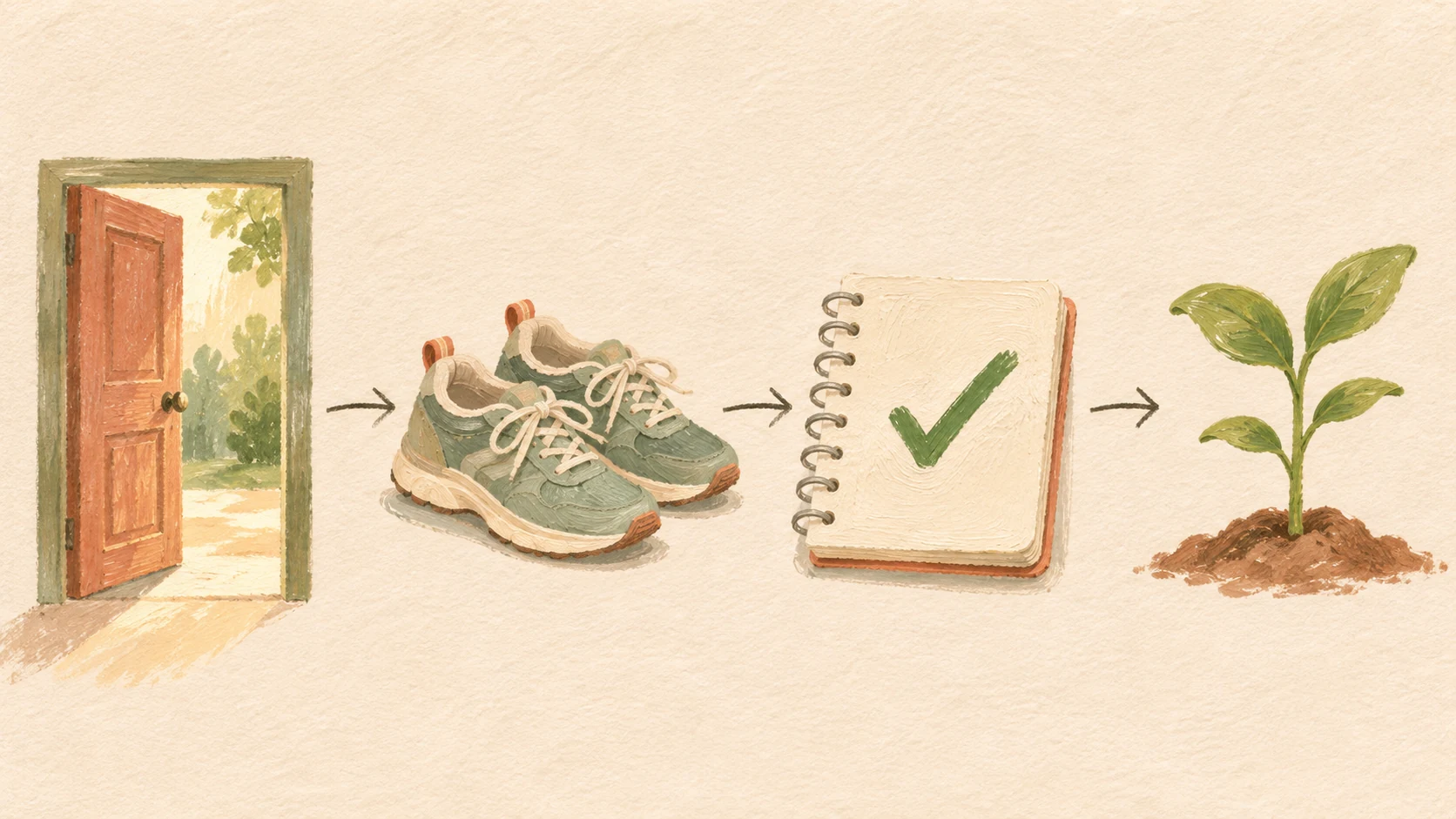
A completion record is a mark that says whether the action you defined happened. A paper calendar, notes app, spreadsheet, or simple mental check can work. Use the method you will actually return to. The record needs to answer one question: did the action happen as you defined it?
Use the record as information, not a verdict
Imagine a fictional month in which someone planned to read one page every day and completed that action on 26 of 30 days. The monthly completion rate is 26 ÷ 30, or about 87%. The current streak depends on the order of the missed days. Both counts describe behavior. Neither proves or disproves that the reader is “a reader.”
A monthly record and a streak answer different questions. The month shows how often the planned action happened across the period. The streak shows consecutive completions. An empty box does not erase earlier checkmarks. If remembering exact days matters, record the action near the time it happens instead of filling in uncertain entries later. The calculation is 26 completed days divided by 30 planned days, multiplied by 100. That gives 86.7%, rounded to 87%.

At the end of a week, use this three-question review: could you observe the action, did the cue show up, and did the plan respect the time you had? If the action happened but the cue failed, move the cue. If neither fit, make the action smaller or choose another. Change one part and keep the rest steady long enough to see whether the plan fits. This review is a practical sorting tool, not a validated behavior-change test.
The Atomic Habits summary with practical tracker moves covers Clear’s Four Laws framework. His article on starting new habits explains the framework, which describes ways to shape a behavior. Identity-based habits describe why that behavior might matter to you. The two ideas can sit together, but you do not need to use every framework at once. The publisher’s book page identifies Atomic Habits as Clear’s book, where he develops these ideas.
What keeps the idea grounded
Identity language can become heavy when every checkmark seems to carry a judgment. Keep the action separate from the conclusion. “I read on four planned days” is a record. “I am not a reader” is a broad label the record cannot establish.
A missed action can also point to a practical problem. Perhaps the cue was hidden by a change in routine. The action may have been too large for the available time. Or the goal may no longer matter as much as it did. Those are different situations, and each suggests a different next step.
Do not use a tracker to grade your character. Decide whether the action still suits you, then make the next opportunity easier to recognize. If the identity no longer fits, you can choose a different one. Your past checkmarks remain a record of what happened, not an obligation to keep the same goal.
Where the Ultimate Habit Tracker Fits
The Ultimate Habit Tracker (ultimatehabittracker.site) is a spreadsheet for recording habits over a month and across the year. It includes 12 monthly trackers, daily checkbox grids, a Habit Dashboard, Streaks & Comebacks, and a Habit Patterns view. You can type habits once in Setup and reuse them across the monthly tabs.
For this approach, a monthly checkbox can record the small action you defined, while the streak view shows consecutive days separately. The workbook includes Excel and Google Sheets versions, plus printable habit pages and a video tutorial. It does not send reminders or notifications, so use another method if you need automatic prompts.
A spreadsheet is one format among several. If you prefer a notebook or a lightweight app, those can also hold the same action and record. If you want a reusable month grid with both a monthly view and streak information, see the Ultimate Habit Tracker. Its setup supports up to 25 habits, and you can start with only one. For a different format, the habit tracker template guide compares ways to keep a record.
Why Trust This Article
The Cosmo Suite team makes the Ultimate Habit Tracker, so we have a commercial interest in spreadsheet tracking. We checked James Clear’s published explanation on 5 November 2026. The 26-of-30 example is fictional arithmetic, not customer data or a product test. Read the about page and editorial policy for more on the publisher and how we handle sources.
Frequently asked questions
What are identity-based habits?
Identity-based habits are actions connected to the kind of person you want to become. James Clear describes repeated actions as evidence that can support a chosen identity. You can apply the idea by choosing one behavior, deciding when it fits, and recording whether you did it. It is a reflection tool, not a test of your worth.
How do I start an identity-based habit?
Name a quality you want to express, such as being a reader or someone who keeps in touch. Choose one small action that fits it, define what counts, and connect it to a moment in your day. Record the action after it happens. Keep the first version small enough to repeat on an ordinary day.
Do identity-based habits work?
The phrase describes a way to think about behavior, not a guarantee. James Clear presents repeated actions as votes for an identity. That framing may help you choose a concrete next step, but a check mark cannot prove a lasting change. Your schedule, circumstances, and preferences still matter.
What is the 3-3-3 rule for habits?
There is no single 3-3-3 habit rule established by James Clear’s identity-based habits article. Different creators may use the phrase for different routines. Check the source of the version you saw before treating it as a standard method. You can begin without it: choose one action and a clear cue.
What are seven atomic habits?
James Clear’s Atomic Habits is commonly organized around four laws for building a habit, rather than a standard list called seven atomic habits. For this identity-based approach, focus on a behavior you can choose and observe. A small action such as reading one page can be easier to record than a broad goal like becoming well-read.
Can a habit tracker help with identity-based habits?
A tracker can record the action you chose, such as reading one page or preparing tomorrow’s lunch. It cannot determine what that action says about you. Use the record to notice what fit your schedule and what you might adjust. Leave a missed day as a missed day, not a judgment about your identity.
What are the four types of habits?
There is no universal four-type classification in James Clear’s identity-based habits article. His separate Four Laws framework covers making a habit obvious, attractive, easy, and satisfying. Those are design principles for a behavior, not four types of people or identities.