Atomic Habits Summary: Four Ideas, Four Tracker Moves
atomic habits summary: see how James Clear’s four laws translate into practical tracker moves, with one fictional month example and a way to use each idea.
By Ultimate Habit Tracker by Cosmo Suite · Editorial policy
Published · 8 min read

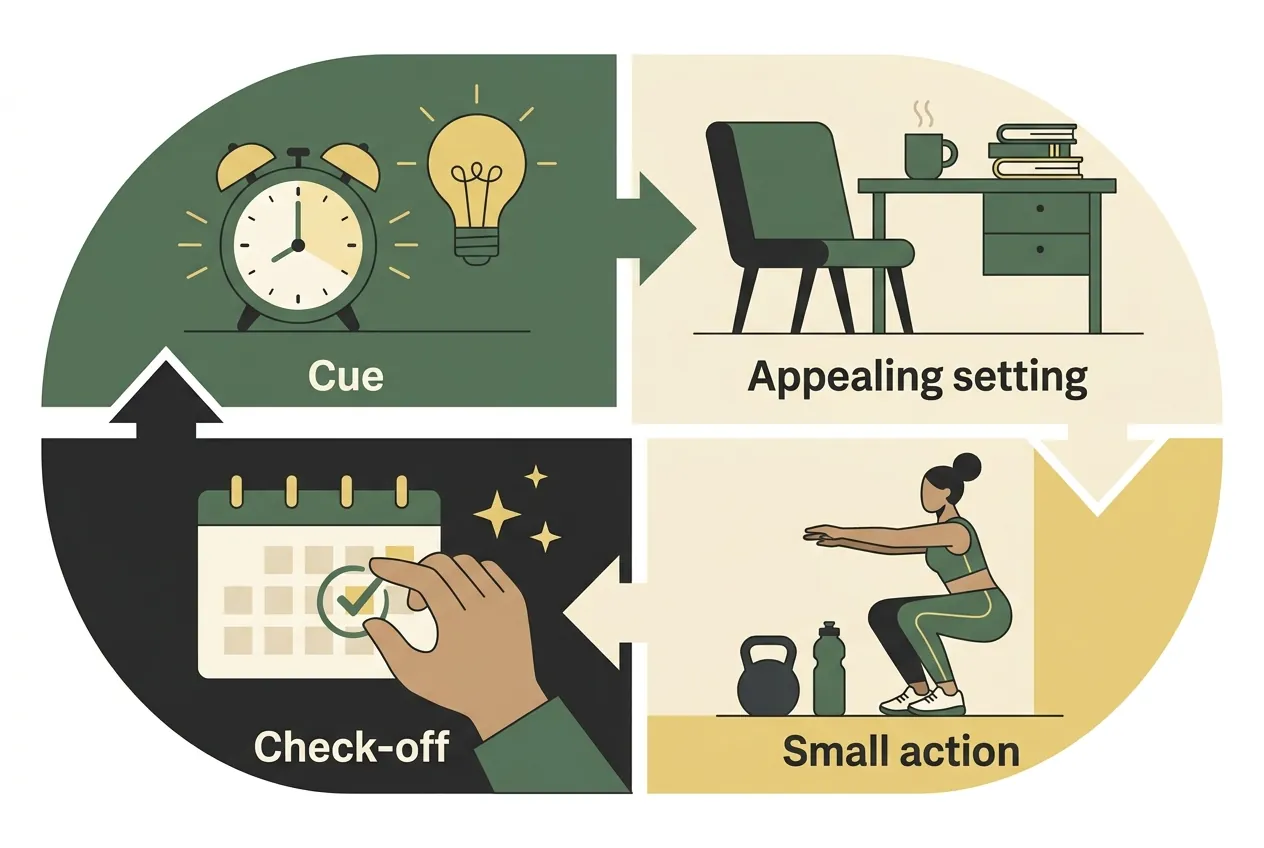
When you read an Atomic Habits summary, the useful question is what to do with the ideas on an ordinary Tuesday, when the plan competes with everything else. James Clear’s book offers four laws for building habits. Each law can guide a small change to a cue, an action, or the way you notice that you followed through.
In brief, make the habit easy to notice, appealing enough to choose, small enough to start, and satisfying to repeat. A habit tracker can record whether the action happened. It cannot supply the cue, motivation, or time for you. Use the ideas as a way to adjust your plan, then keep only the parts that fit your day.
What Atomic Habits is about
Atomic Habits is a 2018 book by James Clear about building and changing everyday behaviors through small actions. Its Four Laws of Behavior Change are make it obvious, make it attractive, make it easy, and make it satisfying. Clear also describes reversing those laws when trying to make an unwanted habit less likely.
The book connects those laws to a four-part habit loop: cue, craving, response, and reward. In practical terms, something signals an opportunity, you want a result, you take an action, and you experience an outcome. The framework gives you places to look when a habit is hard to start or repeat.
A tracker records the action after it happens. It does not make the action attractive or create time for it. If you want a simple way to record a cue and the response, a habit tracker spreadsheet provides a monthly checkbox grid. The book’s author also explains how to track a habit and use the record as feedback.
Atomic Habits at a Glance
The author’s four-step article also describes these laws. The matching tracker moves below are practical applications of the framework.
| Law | A practical question | Tracker move | Best for |
|---|---|---|---|
| Make it obvious | What will remind me this is the moment? | Write the cue beside the action | A habit you forget to start |
| Make it attractive | What would make this feel more appealing? | Pair it with a routine or setting you like | A habit that feels like a chore |
| Make it easy | What is the smallest useful version? | Define the check-off action before the day starts | A plan that feels too large |
| Make it satisfying | What will help me notice I followed through? | Mark the action and review the month | A habit with a delayed payoff |
The first three laws shape what happens before or during the action. The fourth gives you a way to notice completion afterward. Start with the row that matches the problem you see; you do not need to redesign all four parts at once.
Clear also links habits with identity: repeated actions can provide evidence for the kind of person you want to become. His identity-based habits article explains the idea. Treat it as a direction, not a daily score. Pick a behavior that fits that direction, then record the behavior itself. One empty day does not settle what you are capable of doing or who you are.
Turn each law into one small move
The laws are most useful when they change something concrete. Pick one behavior you already want to do, such as reading a few pages, taking a walk, or putting your phone away at a chosen time. Then decide what the cue, action, and record will be.
Make it obvious: name the cue
A cue is the situation that tells you an action can begin. “Read more” leaves the moment open. “After I put my cup in the sink, I will read one page” names a point in the day and a first action.
A cue can be a time, place, or routine that already exists. Write it where you plan the habit, and check whether it occurs often enough to be useful. If the cue is “when I get home” but your arrival time changes, you may need a more reliable event, such as putting your keys down.
This is close to an implementation intention, a written link between a situation and a response. Our guide to if-then plans for everyday habits has more examples. A tracker records whether the action followed the cue; it does not alert you when the cue arrives.
Make it attractive: adjust the setting
A habit feels easier to choose when its immediate setting appeals to you. You might leave a book beside the chair where you read, choose a walking route you enjoy, or pair a routine task with music. The point is to make the action more inviting in your actual environment.
You can also notice what part of the habit you enjoy. If you like being outdoors but dislike planning a long route, choose a familiar short walk. If the pairing stops feeling useful, change it. The tracker is only a record of the habit you chose, not a rating of how much you enjoyed it.
Make it easy: define the starting action
A large goal can hide the first step. “Exercise more” could mean many things, while “put on walking shoes” is a visible action you can decide to count. Choose a version that feels small enough to start, then let extra effort stay optional.
Write down what qualifies for a check-off before you begin. If reading one page is the planned version, do not silently change the minimum to ten pages after a good day. That keeps the record consistent. You can still read more whenever you want.
If the action still feels hard, look for friction. Is the equipment put away? Is the time awkward? Is the first step unclear? Change one of those conditions, then see whether the new version fits. A habit can be reduced or redesigned without calling the earlier attempt a failure.
Make it satisfying: notice the action
A habit tracker is a way to record whether you did a behavior. Some habits have a result that takes time to see. A check-off gives you an immediate record of the action itself. That small mark can show that you followed your plan today, even when the larger outcome is not visible yet.
Keep the reward honest. A filled box means you did the action you defined. It does not prove that the habit is automatic or that it will lead to a particular result. Reviewing a month can help you see when the action happened and where the plan may need to change.
A worked month with four missed days
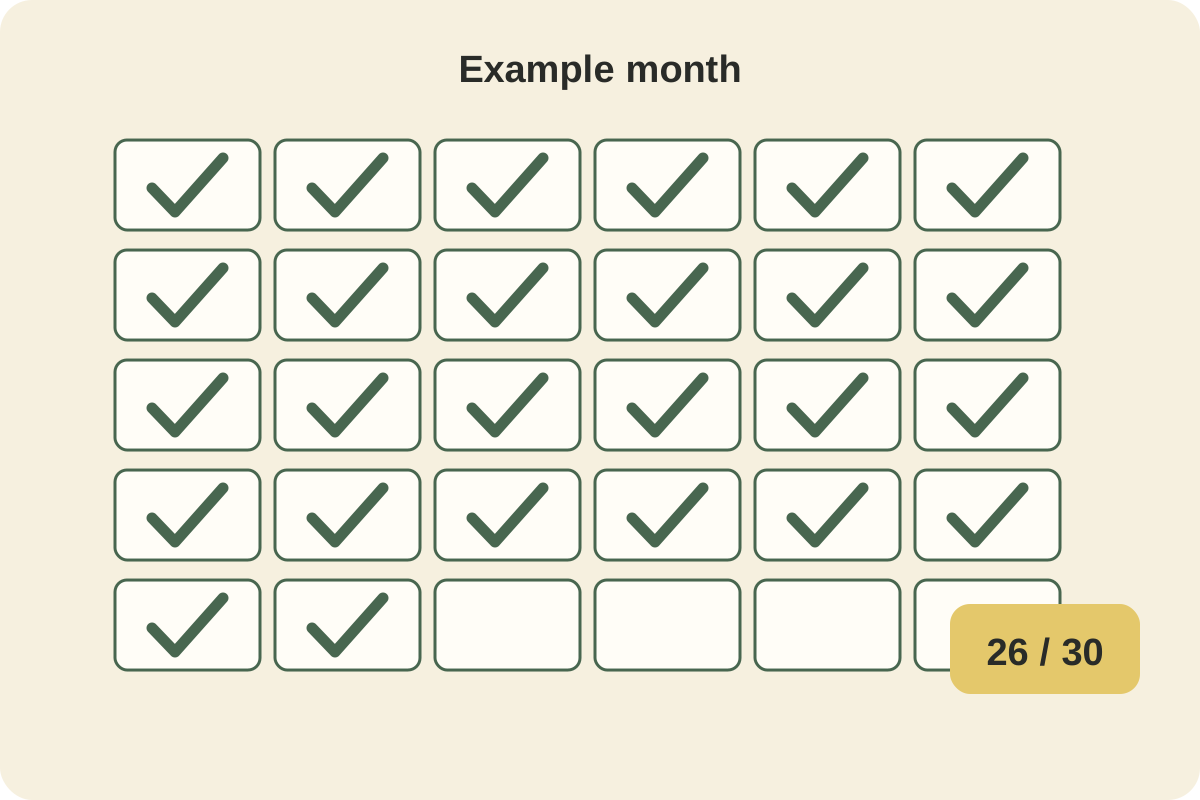
Imagine a fictional 30-day month for reading one page after breakfast. The cue is breakfast ending, the planned action is one page, and the record is one check-off for each day the page gets read. In this example, the reader completes the action on 26 days and misses 4.
The completed share is 26 ÷ 30, or about 0.87 of the planned days. If the four missed days fall separately, the current streak ends at each miss, even though the monthly record still shows 26 completed days. If two misses are adjacent, the streak pauses or ends according to the tracker’s rule, while the monthly count remains 26.
The streak answers, “How many days in a row did I do it?” The month count answers, “How many planned days did I complete?” Choose the measure that helps you decide what to adjust next.
| What the record says | What it can help you ask |
|---|---|
| 26 of 30 days completed | Did the plan fit most days? |
| 4 empty days | Was the cue missing, or did the day change? |
| A shorter current streak | Is a consecutive run useful for this habit? |
| One small action repeated | Should I keep this version or adjust it? |
This is an example, not a result from a product test or a promise about what a tracker will make you do. A paper calendar or a basic list can record the same information. If you use a spreadsheet, choose one whose monthly percentage and streak are clearly separate, as shown in this habit tracker spreadsheet guide.
What helps you come back to the plan
Use the four laws to identify a specific point of friction. If you forgot, make the cue easier to notice. If you resisted the action, make the first step smaller or change the setting. If you did the action but did not notice it, record it in a way you will see later.
Then give the plan enough room to meet real life. A missed day does not erase earlier check-offs. Decide what your tracker does after a miss: leaves an empty box, lets you fill in a forgotten day, or marks a streak break. Those are recording choices. They do not tell you whether you are a consistent person.
At the end of a week, review one question: what made the action easier or harder to start? Adjust one part, such as the cue or action size. Avoid adding multiple rules when you have not yet seen what the first change does.
A short review can follow the four laws without turning into a second project. Check whether you noticed the cue, wanted to do the action, could start it, and felt a useful sense of completion. You are looking for one practical adjustment. If the cue rarely occurred, choose another. If the task still felt large, shrink the first step. If the check-off felt like paperwork, use a simpler record or stop tracking for a while.
Some habits also need a real opportunity, tools, or help from another person. A tracker cannot create those conditions. Keep the framework flexible enough to account for the parts of the day you cannot control.
If you prefer a broader monthly view, a habit tracker spreadsheet with a month score can show the completed days alongside a streak.
Why trust this article
We are the Cosmo Suite team behind the Ultimate Habit Tracker, so we have a product interest in spreadsheet tracking. This article summarizes James Clear’s published framework and labels the tracker examples as applications. The publisher lists the book as published in 2018. We checked the author’s summary and publisher’s book page on 2 November 2026. For how we prepare articles, read our about page and editorial policy. Use the ideas as general habit-planning information, not health advice.
Where the Ultimate Habit Tracker fits
The Ultimate Habit Tracker (ultimatehabittracker.site) is a spreadsheet for Excel and Google Sheets. Its monthly tabs include a daily checkbox grid and monthly percentage. The Streaks & Comebacks tab records current and longest streaks and comebacks. This can help you keep a month visible when a streak pauses.
You enter a habit once in Setup, then check it off in the monthly grid. The sheet does not send reminders or notifications. You choose the cue and the action, then use the checkboxes to record what happened. The habit tracker spreadsheet details list the included tabs and formats.
The file includes 12 monthly trackers, a habit dashboard, printable pages, and a video tutorial. It costs $9 once, with Excel and Google Sheets versions included. A paper calendar or a free app may suit you better if you prefer it.
Frequently asked questions
What is the main idea of Atomic Habits?
James Clear’s book presents habit change as a set of small, repeatable actions shaped by cues, the environment, and rewards. Its Four Laws give readers a practical way to make a wanted habit easier to notice, want, start, and repeat. A tracker can record the action, but it cannot make the decision for you.
What are the four laws in Atomic Habits?
The four laws for building a good habit are make it obvious, make it attractive, make it easy, and make it satisfying. Clear presents the reverse for breaking a habit: make it invisible, unattractive, difficult, and unsatisfying. This summary focuses on using the four building laws to shape an everyday habit.
What is the fastest way to apply Atomic Habits?
Choose one habit and write down its cue, the smallest useful action, and how you will mark it as done. Put the cue where you can notice it, make the action easy to begin, then review the record after a week. Change one part if the plan does not fit your day.
Does Atomic Habits say to track every habit?
No. The book discusses tracking as one possible way to make progress visible. Start with a small number of actions you care about. A long list can take more attention to maintain, and tracking is optional if a simpler cue or routine works better for you.
How do you use a habit tracker with the four laws?
Use the tracker to record what happened after you choose a cue, make the action easy to start, and decide what will feel satisfying. Check off the action you defined in advance. The record can show missed days and completed days, but it does not create reminders or guarantee consistency.
Is Atomic Habits still useful if I miss a day?
Yes. A missed day is information about how the plan met your real schedule. Look at what made the cue or action hard to follow, then decide whether to change the time, place, action size, or record. You can resume at the next suitable opportunity without treating one empty box as a verdict.
What is the quickest way to track Atomic Habits ideas?
Pick one behavior, write its cue and small action, and record only whether you did that action. After a week, review whether the cue was clear and the action fit. A monthly sheet can also show completed days across the whole month, even when a streak pauses.
